
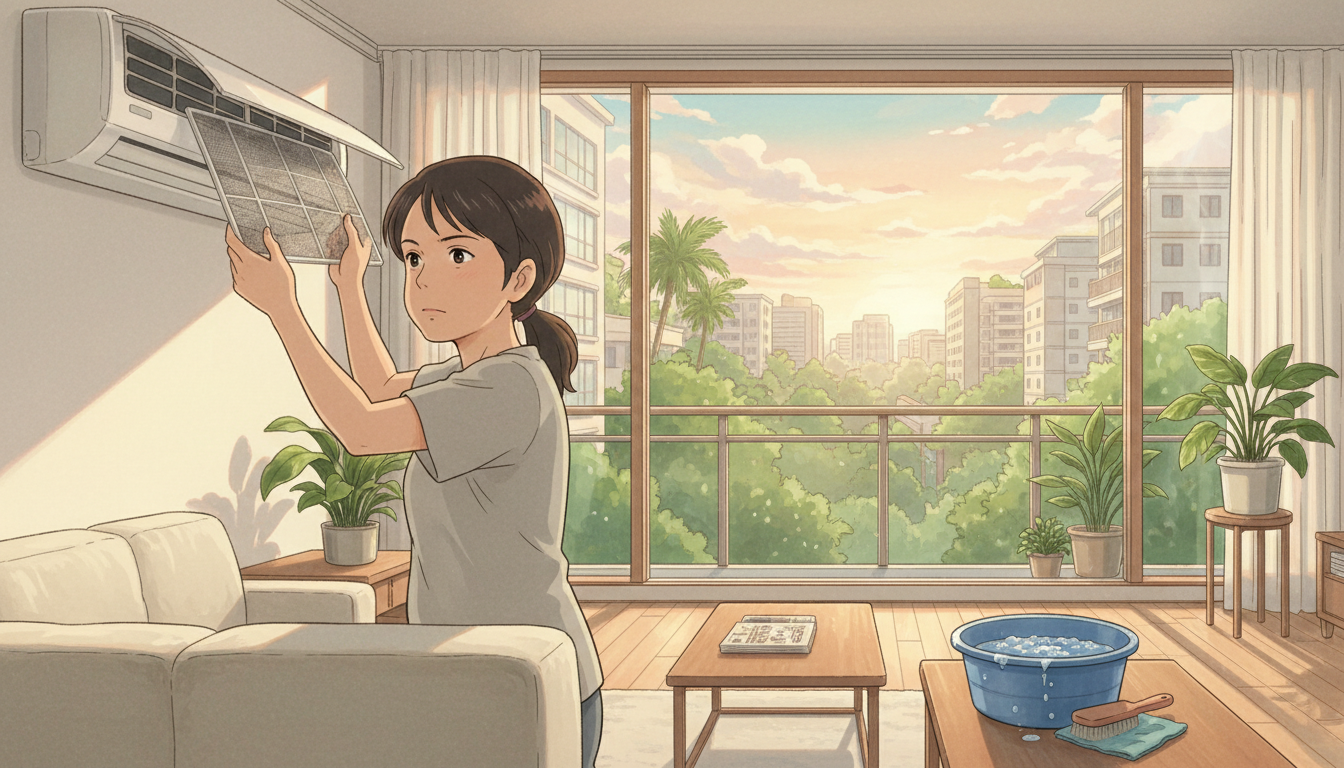
Keeping your home cool in Singapore’s heat means your air conditioner is working hard almost every day. To keep it safe, efficient and comfortable, knowing how to clean aircon filter at home is one of the simplest but most powerful DIY habits you can build. This guide gives Singapore homeowners and tenants a detailed, safety-first process for DIY aircon cleaning, explains when professional servicing is still essential, and shows how Homejourney helps you book trusted aircon technicians when DIY is no longer enough.
Executive summary: Why aircon filter cleaning matters in Singapore homes
In Singapore’s hot and humid climate, dust, cooking fumes and airborne particles build up quickly on aircon filters, especially in HDB flats and condos where windows are often closed and units run for long hours. Clogged filters reduce cooling performance, increase electricity use and can cause odours or even mild allergy symptoms, especially in bedrooms and children’s rooms.
Most split-unit air conditioners in HDB and condo apartments use washable mesh filters that can be cleaned safely at home with a simple aircon filter wash using mild detergent and lukewarm water. If you clean your filters every 1–3 months and combine that with periodic professional servicing, you will usually avoid major breakdowns and higher long-term costs while keeping your home more comfortable.
However, DIY has limits. Deep issues like water leakage, persistent bad smells, icing, or poor cooling despite clean filters often need professional help, from general servicing (around $22 per unit) to chemical overhaul (around $110 per unit) or gas top-up (about $80 flat rate), based on current 2026 market norms. When that happens, Homejourney lets you book verified aircon providers with transparent pricing and real reviews in minutes via Aircon Services .
Understanding your aircon: Singapore home context
Common aircon setups in HDB, condo and landed homes
In most Singapore homes, you’ll see these aircon configurations:
- HDB flats: Typically a multi-split system (2–4 indoor units) mounted high on bedroom and living room walls, connected to one outdoor compressor on the aircon ledge.
- Condo units: Similar multi-split systems, but cleaning access can be affected by interior design (false ceilings, built-in carpentry) and MCST rules about work on common areas.
- Landed homes: Larger multi-split or VRV/VRF systems, sometimes mixed with window or portable units in older properties.
The filter cleaning
What your aircon filter actually does
The indoor unit’s mesh filter is designed to trap larger particles like dust, hair and lint before air passes over the evaporator coils. This protects the coils and helps keep the air flowing smoothly, but it is not a high-grade HEPA or PM2.5 filter. In typical Singapore usage, these filters clog noticeably in about 1–3 months, faster in homes near busy roads, construction sites, or where cooking is frequent with doors and windows closed.
When the filter is dirty, you may notice:
- Aircon not as cold even with the same temperature setting.
- Weak airflow compared to when the unit was new or recently serviced.
- More dust around the vents.
- Mild musty smell when the unit starts up.
Cleaning the filter removes the trapped dust so air can flow properly again, often restoring cooling without any technical repairs.
Service types in Singapore: DIY vs professional options
General servicing: What it includes and typical pricing
General servicing
- Removal and washing of filters and front panel.
- Brushing and light cleaning of evaporator coils.
- Vacuuming of drainage pan and clearing of drain pipe.
- Basic checks on gas pressure, wiring and operation.
Typical 2026 Singapore prices for general servicing start at about $22 per unit
General servicing is recommended every 6–12 months for average residential use, even if you do DIY aircon cleaning
Chemical overhaul: Deep cleaning for problem units
A chemical overhaul
- There is persistent mould or strong musty odour.
- The unit leaks water frequently despite normal servicing.
- Cooling is poor due to heavily clogged coils.
- The fan is noisy from heavy dirt accumulation.
In 2026, chemical overhaul is commonly priced around $110 per unit
Gas top-up: When refrigerant is the issue
Gas top-up
- Air is cool but not cold even at low temperature settings.
- Outdoor compressor running continuously without reaching set temperature.
- Ice forming on the indoor coil (though dirty filters can also cause this).
Current market pricing for gas top-up in Singapore is typically around $80 flat rate
Where DIY filter cleaning fits in
DIY aircon filter wash does not replace general servicing or chemical overhaul, but it does:
- Reduce how fast the unit gets dirty.
- Improve daily cooling and comfort.
- Lower electricity consumption by easing airflow.
- Extend time between more expensive services.
Think of DIY filter cleaning as routine home AC maintenance you can safely do, while professional servicing is periodic in-depth care to keep the entire system healthy. Homejourney helps you balance both: clean filters yourself and use Aircon Services to book vetted technicians when deeper work is due.
Safety-first: Before you start cleaning your aircon filter
Critical safety checks for Singapore homes
Whether you live in a Punggol 4-room HDB, a Clementi condo or a landed home in Serangoon, the safety principles before DIY aircon cleaning are the same:
- Switch off the aircon via the remote. This stops the fan and compressor.
- Turn off the wall switch (isolator) for the indoor unit. In HDB flats, this is usually beside or below the unit; in condos, it might be hidden near curtains or behind furniture.
- Do not stand on unstable chairs or boxes. Use a proper step stool or ladder with someone nearby if the unit is very high.
- Avoid water dripping into electrical points. Always bring filters to the bathroom or kitchen sink for washing; do not wash them while still mounted.
According to multiple Singapore guides, turning off power at the isolator before opening panels is strongly recommended to eliminate electrical risk. If you have any doubt about your unit’s power connection, consult the original installer or a professional via Homejourney rather than experimenting.
Check building and MCST rules (for condos)
DIY filter cleaning normally does not require any special permission. However, in some condominiums, the MCST (Management Corporation Strata Title) has rules about:
- Using ladders near windows and balcony railings.
- Accessing aircon ledges or common property.
- Running water onto aircon ledges or external walls.
For simple filter washing inside your unit, you are usually free to proceed. But if you plan to clean external components or need to access the aircon ledge, check with your MCST first and consider booking a licensed contractor via Homejourney to avoid safety and liability issues.
Tools and materials you need for DIY aircon filter wash
Basic tools most Singapore homes already have
For a standard split-unit DIY aircon cleaning focused on filters, you only need simple household items:
- Soft cloth or microfiber rag (for wiping the panel).
- Vacuum cleaner with a soft brush attachment (optional but helpful).
- Small basin or bucket for soaking filters.
- Soft brush (old toothbrush or small dish brush).
- Mild dishwashing liquid or gentle detergent.
- Lukewarm tap water (avoid hot water).
Optional cleaning solutions for odour and light mould
If your filters have mild odours or light mould spots, some Singapore guides recommend gentle solutions:
- Baking soda: A tablespoon added to the wash basin helps neutralize smells.
- Vinegar solution: Up to a 1:1 vinegar-water mix for soaking certain filter types, but only if the manufacturer allows it.
For typical HDB and condo mesh filters, a simple detergent and water mix is usually sufficient. Strong chemical cleaners or bleach should be avoided because they can weaken plastic frames and mesh or leave irritating residues.
Step-by-step: How to clean aircon filter at home
Quick reference: DIY aircon filter cleaning steps
| Step | Action | Key points |
|---|---|---|
| 1 | Turn off power | Use remote and wall isolator switch for safety. |
| 2 | Open front panel | Lift panel gently until it clicks; support it with one hand. |
| 3 | Remove filters | Slide mesh filters out carefully without shaking dust. |
| 4 | Vacuum dust | Use soft brush vacuum from dusty side to remove loose particles. |
| 5 | Wash with detergent | Soak 10–15 minutes in lukewarm water with mild soap; gently scrub. |
| 6 | Rinse thoroughly | Rinse under running water until no soap remains. |
| 7 | Air dry completely | Dry in shaded, ventilated area; avoid direct sun and hairdryers. |
| 8 | Reinstall and test | Slide filters back, close panel, restore power and test cooling. |
Step 1: Turn off the aircon and power isolator
Press the OFF button on your aircon remote to stop the unit. Then locate the wall switch (isolator) that controls the indoor unit and switch it off. In many HDB flats, this is just below the indoor unit or near the room entrance; in condos it may be slightly hidden behind curtains or built-in carpentry.
Turning off power at the isolator is important because it prevents accidental fan movement or electrical issues when you open the panel and touch internal parts.
Step 2: Open the front panel safely
Most split-unit indoor panels open with a gentle upward lift:
- Place both hands on the sides of the panel.
- Look for small indentations or finger grips at the bottom edge.
- Lift the panel upwards until you feel it click into an open position and stay up.
If your unit feels stuck, do not force it. Some designs require a small screwdriver to release hidden clips or screws. Check your model’s instruction manual, especially in newer condos where units are partially concealed by carpentry.
Step 3: Remove the mesh filters
Once the panel is open, you will see one or two curved mesh filters just behind the panel. To remove them:
- Hold the lower edge of the filter.
- Gently push upward to release it from the locking clips.
- Slide the filter downward and out of the unit, minimizing shaking to avoid dust falling into the room.
Remember how the filters are oriented; many have arrows showing the correct airflow direction so you can reinstall them properly later.
Step 4: Vacuum off loose dust (optional but recommended)
If you have a vacuum cleaner with a soft brush attachment, use it to remove the bulk of loose dust before washing:
- Place the filter on a flat surface (e.g., bathroom floor or balcony).
- Vacuum from the front (dusty) side first to pull debris out of the mesh.
- Use gentle pressure to avoid damaging the filter material.
This step makes washing more effective and reduces how much dirt goes into your sink or basin.
Step 5: Wash the filter with mild detergent
Fill a basin with lukewarm water and add a few drops of mild dishwashing liquid or gentle detergent. Avoid hot water, as it can warp or shrink some filter materials.
- Submerge the filter fully and let it soak for about 10–15 minutes.
- Use a soft brush to gently scrub both sides, focusing on visibly dusty areas.
- For odours, add a spoonful of baking soda to the solution to help neutralize smells.
Do not use harsh chemical cleaners, bleach, or strong solvents. They can damage plastic frames and mesh and may leave irritant residues in the air stream.
Step 6: Rinse thoroughly under running water
After scrubbing, rinse the filters under running tap water until all soap is removed:
- Hold the filter under a gentle stream from the back (clean) side; this helps push dirt out of the mesh instead of deeper into it.
- Continue rinsing until the water runs clear and no bubbles remain.
Proper rinsing is important to avoid drying soap residue on the mesh, which can attract more dirt and restrict airflow.
Step 7: Air dry completely in a shaded area
Shake off excess water and place the filters upright or flat in a shaded, well-ventilated area to air dry fully.
- Do not place filters under strong direct sunlight, especially midday sun; heat can warp delicate plastic frames.
- Do not use hairdryers or other high-heat sources.
- Allow at least 30–60 minutes for light cleaning and up to a few hours if filters were heavily soaked.
Never reinstall filters while damp. Moisture trapped inside the unit can promote mould growth on coils and the drainage pan.
Step 8: Reinstall filters, close panel and test
Once the filters are completely dry:
- Slide them back into their tracks following the original orientation (check arrows if present).
- Press the bottom tabs gently until they click into place.
- Close the front panel and ensure it locks securely.
- Turn on the wall isolator switch, then use the remote to start the aircon.
Let the unit run for several minutes and check that airflow feels stronger and cooling is back to normal. If performance is still poor, it may be time to book general servicing or further diagnosis through Aircon Services .
How often should you clean your aircon filter?
Recommended frequency for Singapore households
Given Singapore’s climate and typical usage patterns, a good rule of thumb for home AC maintenance is:
| Usage pattern | Example | Recommended filter cleaning frequency |
|---|---|---|
| Heavy use | Unit runs nightly in bedroom + daily in living room | Every 1–2 months |
| Moderate use | Used mainly at night or weekends | Every 2–3 months |
| Light use | Occasional use for guests or hot spells | Every 3–4 months |
| Dusty environment | Near main roads, construction sites or heavy cooking | Increase cleaning by one level (e.g. monthly) |
Singapore guides commonly recommend regular cleaning at least every few months to keep filters dust-free. In practice, many homeowners in estates like Tampines, Jurong and Woodlands report visible dust build-up within 6–8 weeks when units run almost every night.
When to choose professional servicing instead
DIY cleaning focuses on filters and basic exterior care. You should consider professional servicing via Homejourney when you notice:
- Water leaking from the indoor unit onto the wall or floor.
- Strong musty or chemical smells when the unit turns on.
- Very weak airflow even after filter cleaning.
- Ice on the indoor coil or unusual noises from the fan.
These signs usually indicate issues in coils, drainage or refrigerant rather than just dirty filters. Booking general servicing or chemical overhaul through Aircon Services will be safer and more effective than repeated DIY attempts.
Singapore-specific considerations: HDB, condo and regulations
HDB flats: Practical tips from daily experience
In HDB estates like Yishun, Bedok and Bukit Panjang, most aircon indoor units are mounted near the ceiling in bedrooms and living rooms. Based on lived experience in such flats, practical tips include:
- Plan a cleaning route: Keep a stable step stool in each room; avoid moving a tall ladder through narrow hallways.
- Coordinate with family: Clean bedroom units earlier in the day so filters are dry well before bedtime.
- Kitchen units: If you have an aircon near the kitchen, expect faster grease and odour build-up; clean these filters more frequently.
HDB’s main regulations relate to installation (placement of compressors, aircon ledges, and trunking), not to simple filter cleaning. As long as you are not modifying structural elements or external walls, DIY filter washing is generally permitted.
Condo units: MCST and access constraints
In condos from Sengkang to Bukit Timah, aircon units may be partially concealed in false ceilings or over built-in cabinets. Cleaning filters here can require:
- Longer ladders and more careful planning around furniture.
- Extra care to avoid hitting sprinkler heads or ceiling fixtures.
- Checking MCST rules before accessing aircon ledges or external units.
If your indoor units are hard to access safely, it is better to arrange a professional visit via Homejourney than risk falls or damage. Verified providers in Aircon Services are familiar with MCST expectations and condo layouts, reducing risk for owners and tenants.
Licensed contractors and BCA context
For installations and more complex servicing, Singapore homeowners should engage contractors with appropriate licensing and registration. The Building and Construction Authority (BCA) maintains registers for licensed builders and certain trades, and many reputable aircon firms highlight their compliance with BCA or other relevant regulations on their websites.
While simple filter cleaning is safely within DIY scope, works involving gas, wiring, or structural drilling are not. Homejourney emphasizes verified providers and user reviews so that when you move beyond DIY, you can engage technicians who meet regulatory and safety expectations.
Beyond filters: Basic DIY aircon hygiene you can safely do
Wiping the front panel and louvers
While your filters are drying, it is safe to do some light cleaning on the indoor unit exterior:
- Use a damp cloth to wipe dust from the front panel.
- Gently clean the air vents and movable louvers.
- Dry surfaces with a soft cloth to avoid streaks.
This improves overall cleanliness and appearance without exposing you to internal components or wiring.
Checking the drainage outlet (with care)
Many Singapore guides suggest simple checks on the drainage outlet to prevent minor clogs:
- Ensure the drain outlet near the outdoor unit or bathroom is not visibly blocked by algae or debris.
- If accessible and safe, pour a small amount of diluted white vinegar (1:10) into the drain opening to help reduce slimy buildup.
This should only be done where the drain is clearly visible and easy to reach. If your drain line is hidden, backing up, or leaking indoors, stop DIY efforts and book a professional via Aircon Services .
When DIY isn’t enough: Signs you need a professional
Common problems DIY filter cleaning will not solve
Even after thorough clean aircon filter efforts, some symptoms require trained technicians:
- Persistent water leaks: Often due to clogged drainage pan or misaligned drain pipes; needs proper cleaning and sometimes re-leveling.
- Strong mould odour: Indicates contamination inside coils, blower and pan beyond filter surfaces.
- No cooling despite good airflow: May signal gas pressure issues or compressor faults.
- Frequent on/off cycling or error codes: Could involve sensors or PCB problems.
Attempting to dismantle coils or blowers without training can damage the unit and create safety risks. In these cases, booking general servicing or chemical overhaul through Homejourney is the safer choice.
Homejourney’s role: Safe, trusted aircon servicing
Homejourney is built around user safety and trust, especially for services where technical quality matters. When you need more than DIY:
- Verified providers: All aircon service companies on Aircon Services are vetted before listing.
- Transparent pricing: You see upfront package prices (e.g. general servicing from about $22/unit, chemical overhaul around $110/unit, gas top-up about $80 per system) with no hidden fees.
- Real reviews: Ratings and feedback come from Singapore homeowners who have booked through Homejourney.
- Same-day options: For urgent issues like leaks or total cooling failure, you can request fast-response slots.
For landlords managing several units or tenants who need quick fixes before handover, Homejourney’s service guarantee and transparent process reduce risk compared to sourcing contractors ad hoc.
Aircon service costs and budgeting for Singapore homeowners
How aircon servicing fits into your home budget
When you buy a new HDB or condo unit, it is easy to focus on renovation and furnishings while underestimating recurring aircon costs. Typical annual care for a 3-bedroom HDB with 4 indoor units might look like:
- DIY filter cleaning every 2 months (your time, no direct cost).
- General servicing once or twice a year at roughly $22/unit via a multi-unit package.
- Occasional chemical overhaul or repairs if units are older or previously neglected.
New homeowners comparing properties on Property Search should consider aircon age and condition when budgeting. Pair this with bank financing insights on Mortgage Rates to get a full picture of ongoing homeownership costs, including aircon maintenance.
Data-driven view: Servicing vs neglect
Market analysis from local property coverage such as Business Times Property and Straits Times Housing News often highlight how poorly maintained mechanical systems reduce buyer confidence and rental appeal. An aircon system with clear servicing records and clean operation can be a selling point, especially for high-floor units exposed to sun where cooling is critical.
From a landlord’s perspective, routine filter cleaning and scheduled servicing via Homejourney reduces complaints about comfort and odour, supports tenant retention, and minimizes emergency call-outs at premium rates.
Local insights and examples from Singapore neighbourhoods
Woodlands case study: Heavy use and service patterns
In family-heavy neighbourhoods like Woodlands, aircons often run long hours at night due to warmer west-facing units and multi-generation households. Homejourney’s content on local service costs, such as Home Services in Woodlands Cost Guide: Singapore Prices 2026 , shows that bundling multiple services (aircon, cleaning, minor repairs) can optimize call-out fees.
Homeowners there commonly adopt a pattern of:
- DIY filter cleaning every 1–2 months in bedrooms.
- General servicing twice a year for all units.
- Targeted chemical overhaul on older or problem units only.
This combination keeps costs manageable while maintaining comfort. Similar strategies are applicable across other dense towns like Jurong, Pasir Ris and Hougang.
End-of-tenancy scenarios: DIY vs professional expectations
For tenants preparing to hand back keys, landlords or property agents often expect aircon units to be clean, with no obvious dust or odour. Doing a thorough clean aircon filter plus basic exterior wiping can help meet basic expectations, but many tenancy agreements specifically require professional aircon servicing before handover.
Homejourney’s guides on tenancy cleaning, such as End of Tenancy Cleaning Checklist in Singapore: DIY vs Pros | Homejourney and Choosing an End of Tenancy Cleaning Provider in Singapore | Homejourney , complement this aircon filter guide by helping you decide when DIY is acceptable and when professional invoices are needed as proof.
Homejourney app features that support safe AC maintenance
Integrated home services, not just one-off jobs
Beyond aircon, Homejourney enables Singapore homeowners and tenants to manage broader home maintenance:
- Multiple services: Aircon servicing, cleaning, moving and more in one place.
- Easy booking: Book appointments in minutes via .
- Fast response: Same-day and emergency services for urgent issues.
This matters for aircon because problems rarely occur in isolation. A leaking unit can stain walls or floors, requiring cleaning; moving house may require aircon deinstallation or servicing alongside other works. Homejourney’s single platform reduces complexity and improves oversight.
Transparency and feedback loop
Homejourney’s focus on feedback and verification ensures that aircon service listings are continuously refined:
- Users rate punctuality, cleanliness and technical competence after each job.
- Repeated issues trigger review and potential removal of providers who fall short.
- Pricing is monitored against prevailing Singapore rates to maintain fairness.
This ecosystem encourages providers to maintain standards that align with user safety and long-term trust rather than short-term gains, which is vital when they handle mechanical systems like aircon units in your home.
FAQ: Aircon filter cleaning and home AC maintenance in Singapore
How often should I clean my aircon filter in Singapore?
For most Singapore homes, cleaning filters every 1–3 months is recommended depending on usage. Heavy use (daily in bedrooms and living room) calls for monthly cleaning, while moderate use can manage with every 2–3 months.
Can I use bleach or strong chemicals to wash my aircon filter?
No. Guides from local aircon service companies recommend mild detergent or dish soap in lukewarm water, sometimes with baking soda for odour, but advise against strong chemicals and bleach because they can damage plastic and mesh.
Is it safe to clean aircon filters in a high-floor HDB or condo?
Yes, as long as you use a stable step stool or ladder indoors, turn off the power at the wall isolator, and avoid accessing external ledges or risky positions. For units that are very high or awkwardly placed, book a professional via Aircon Services rather than stretching or leaning dangerously.
Will cleaning filters solve an aircon that is not cold?
Sometimes. Dirty filters can reduce airflow and cooling, so cleaning may restore performance. However, if the unit remains warm after cleaning, issues like dirty coils, gas pressure problems or compressor faults may be involved. In that case, book general servicing or diagnosis through Homejourney.
What is the difference between general servicing and chemical overhaul?
General servicing focuses on cleaning filters, basic coil brushing, drainage clearing and checks, usually around $22/unit in 2026. Chemical overhaul involves dismantling the indoor unit to deep-clean coils, blower and pan with chemical solutions, typically around $110/unit, used for severe dirt, mould or persistent leaks.
Do I need professional aircon servicing before end-of-tenancy?
Many tenancy agreements in Singapore require proof of recent professional servicing (often within 3–6 months of handover). DIY filter cleaning improves condition but may not meet contractual requirements. Check your lease and, if needed, book servicing through Aircon Services and consult related guides like End of Tenancy Cleaning Checklist in Singapore: DIY vs Pros | Homejourney .
Can I clean the indoor coils myself?
Basic vacuuming or brushing near the coils is mentioned in some DIY guides, but thorough coil cleaning, especially with chemicals, is best left to professionals to avoid bending fins, damaging sensors, or causing leaks. For safety and performance, treat coil cleaning as a professional task.
How long should I let the filter dry before reinstalling?
Most filters dry in 30–60 minutes in a shaded, ventilated area after a routine wash, but thicker or heavily soaked filters may need a few hours. Always check that the filter is fully dry to the touch on both sides before reinstalling to prevent mould growth.
Does filter cleaning reduce my electricity bill?
Yes, to an extent. Clean filters allow better airflow, so the system reaches set temperatures more efficiently and the compressor runs less. While savings depend on usage and unit efficiency, regular filter cleaning is a simple way to avoid wasting energy due to preventable airflow restrictions.
Should landlords pay for aircon servicing, or tenants?
Responsibility depends on the tenancy agreement. Some landlords include routine servicing in rent and manage bookings themselves through platforms like Homejourney, while others require tenants to arrange and pay for servicing at specified intervals. Clear documentation and invoices from verified providers on Aircon Services help avoid disputes.
Keeping your aircon filters clean is one of the easiest ways to protect comfort, health and energy efficiency in a Singapore home. Combine regular DIY filter cleaning with scheduled professional servicing booked through Homejourney’s verified aircon providers, and use tools like Property Search , Mortgage Rates and Projects Directory to make informed decisions about the properties and home systems you invest in.