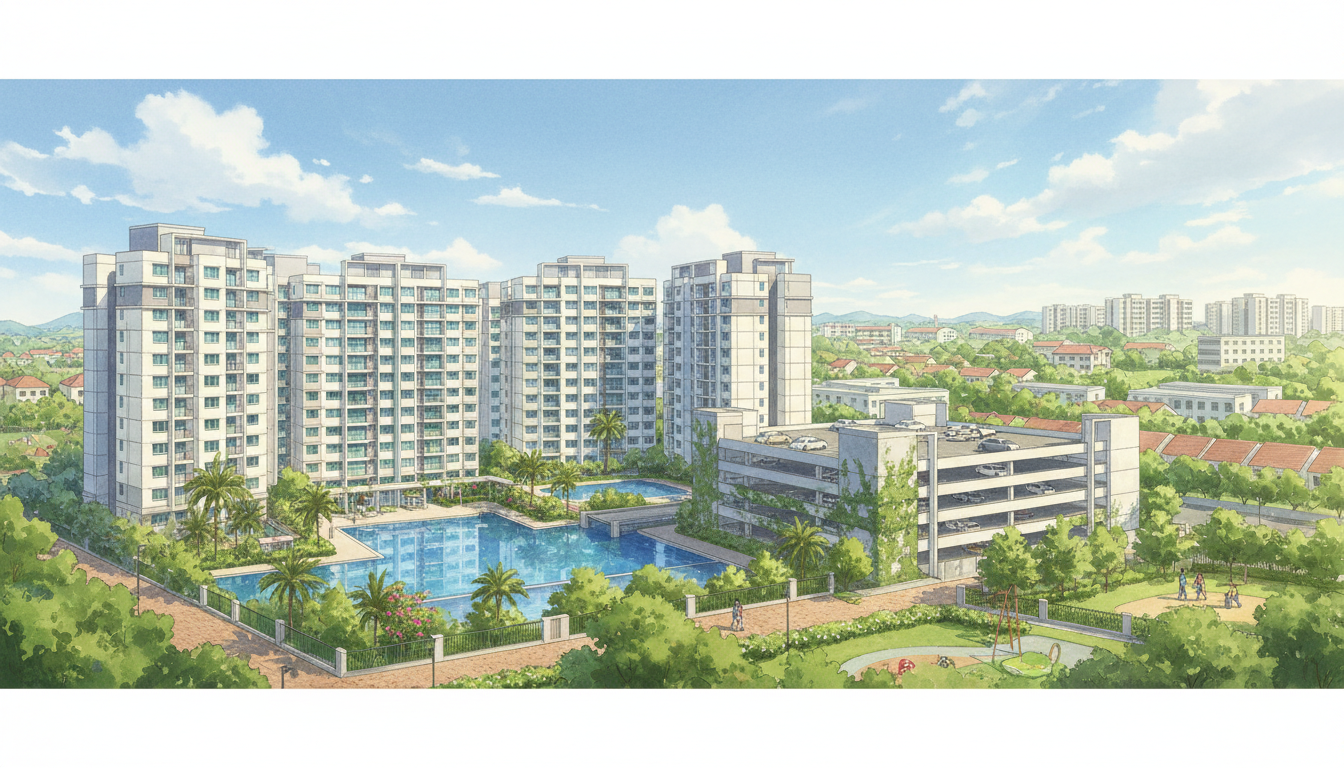
Part of Tenet project analysis
Homejourney Editorial
For property investors evaluating Tenet on Tampines Street 62, the critical question isn't just about current prices—it's about the rental yield potential and long-term capital appreciation that this District 18 development can deliver. Understanding how to calculate, compare, and project these returns is essential for making confident investment decisions in Singapore's competitive residential market.
This analysis examines Tenet's investment fundamentals through the lens of rental income generation and growth prospects, helping you determine whether this Tampines condo aligns with your investment objectives.
Rental yield measures the annual rental income you receive as a percentage of your property purchase price[1]. For Tenet investors, this metric directly answers: "How much income will my investment generate each year?"
Singapore's residential rental market currently averages 2.5% gross rental yield annually[1], though this varies significantly by location and property type. District 18's proximity to employment hubs and established transport links positions Tenet competitively within this landscape.
There are two ways to calculate rental yield:
For Tenet specifically, understanding gross yield helps you compare this development against other District 18 properties, while calculating net yield reveals your true cash-on-cash returns after all expenses.
Singapore's rental market entered a critical stabilization phase in 2025-2026 after surging approximately 50% between 2021 and 2023[2]. Private residential rents posted a full-year gain of +1.9% in 2025, reversing the -1.9% decline of 2024[2], creating what analysts describe as a "Goldilocks equilibrium"—neither overheating nor correcting sharply.
For Tenet investors, this stabilization matters significantly. The market continues to favor landlords, albeit with meaningfully less pricing power than during the 2021-2023 surge[2]. This means rental income growth will be more moderate but more predictable—essential for long-term investment planning.
The rental market's stabilization at elevated absolute levels—with private median monthly rent approximately SGD 4,300 for non-landed units[2]—has supported rental yield calculations for investors even as capital values continue to rise. However, medium-term supply pipeline compression introduces risk to gross rental yields in the 2027-2028 window[2], a consideration relevant to Tenet's medium-term outlook.
Rental demand in District 18 (Tampines and Pasir Ris) is driven by several structural factors that directly impact Tenet's investment potential:
These factors suggest Tenet's rental yield potential is supported by genuine demand fundamentals rather than speculative pricing.
To evaluate Tenet's investment potential, you need to project realistic rental income. Here's the framework Homejourney recommends:
For example, if you purchase a Tenet unit for SGD 800,000 and achieve SGD 2,400 monthly rent (SGD 28,800 annually after accounting for 1-month vacancy), your gross rental yield would be 3.6%—above Singapore's 2.5% average[1], reflecting District 18's premium positioning.
While rental yield generates immediate income, capital appreciation—the increase in property value over time—often represents the larger component of real estate investment returns. For Tenet, several factors support medium-term appreciation:
Property investment experts emphasize that rental yield alone shouldn't drive investment decisions[1]. Instead, evaluate Tenet as a combination of current income generation plus long-term capital appreciation potential.
Singapore's total property investment volume climbed 26.6% year-on-year to SGD 33.3 billion in 2025, with the residential sector contributing 44.9%[2]. This robust investment activity reflects continued confidence in Singapore residential property despite yield compression.
For Tenet specifically, this market context suggests:
Homejourney's commitment to user safety means presenting this context transparently: Singapore's rental yields remain modest by global standards, but the combination of stable political environment, strong currency, and capital appreciation potential justifies investment for those with appropriate time horizons and risk tolerance.
Your financing strategy directly impacts net rental yield. With mortgage rates moderating[2], leveraging becomes more attractive for investors. A property financed at 80% LTV with a 3% mortgage rate generates different net returns than an all-cash purchase.
Use Homejourney's mortgage calculator to model different financing scenarios and understand how interest costs affect your net yield calculations. This transparency helps you make confident decisions about purchase structure.
Responsible investment analysis requires acknowledging risks:
These considerations don't disqualify Tenet as an investment, but they require realistic modeling in your financial projections.
Tenet's investment profile suits specific investor types:
Conversely, Tenet may not suit investors seeking yields above 5-6% or those requiring immediate high cash returns.
To move from analysis to decision, Homejourney recommends this structured approach:
For comprehensive information about Tenet's amenities, location advantages, and floor plans that support rental demand, review our detailed Tenet amenities and location guide.
Based on District 18's market positioning and Singapore's 2.5% average rental yield[1], realistic expectations for Tenet range from 3.0-4.0% gross rental yield, depending on unit type and specific location within the development. Actual yields vary based on purchase price, rental market conditions, and individual property characteristics. Always calculate based on current market rental rates rather than developer projections.
Tenet's yield potential depends on its specific pricing relative to comparable developments. Higher-priced units naturally generate lower percentage yields, while better-positioned units may command premium rents that offset higher purchase prices. Homejourney's project analysis provides detailed comparisons with competing developments to help you assess relative value.
Market analysts expect gradual moderation in rental growth rates through 2027-2028, particularly outside prime CCR districts[2]. While District 18 remains well-positioned, investors should model conservative rental growth assumptions rather than expecting the 3-4% annual increases seen in 2024-2025.
Neither should be prioritized exclusively. Rental yield provides current income, while capital appreciation builds long-term wealth. Successful Tenet investors typically model both components and ensure the combined return profile (rental yield + projected capital appreciation) justifies their investment relative to alternative uses of capital.
If Tenet generates 3.5% gross rental yield, realistic net yield after property tax, maintenance fees (typically 0.5-1.5% annually), insurance, and potential vacancy typically ranges from 1.5-2.5%, depending on your specific financing and cost structure. Always calculate net yield conservatively to avoid overestimating actual returns.
View price trends, transaction history, and nearby amenities for Tenet.