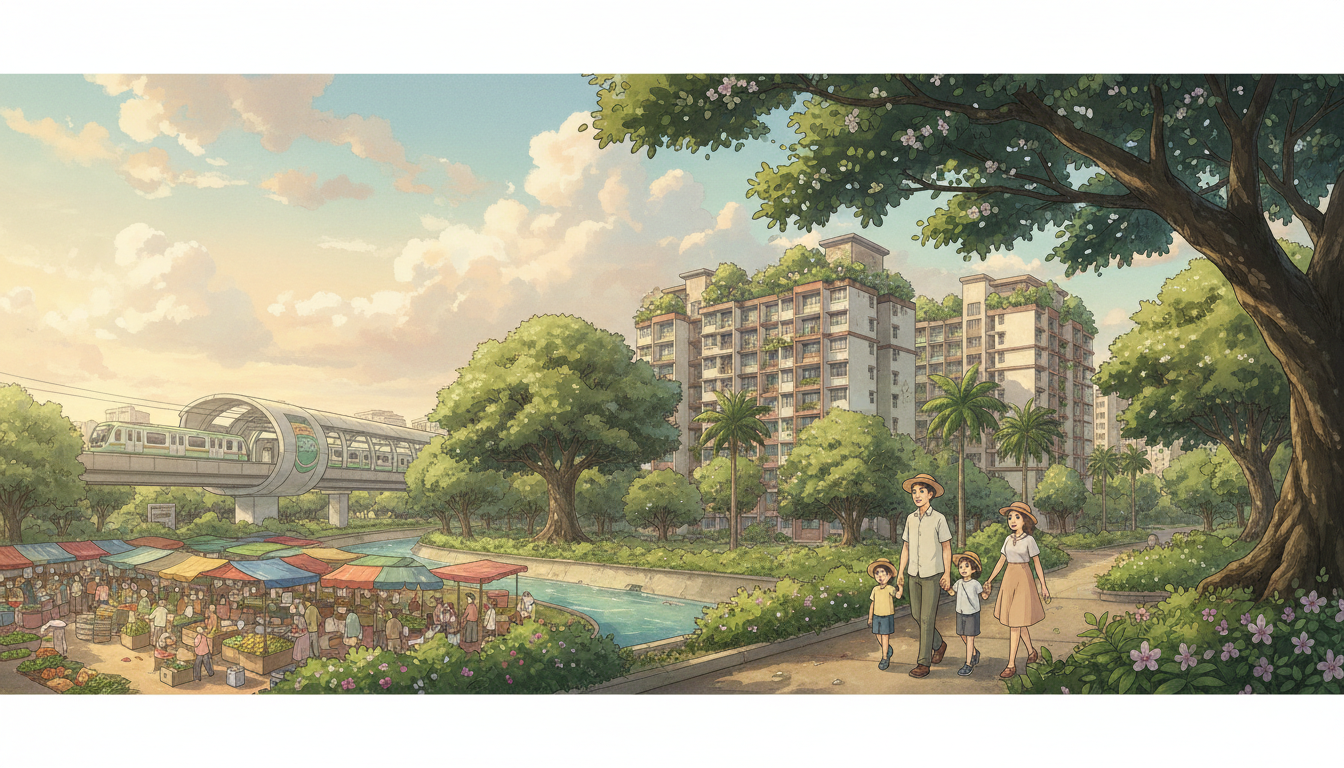
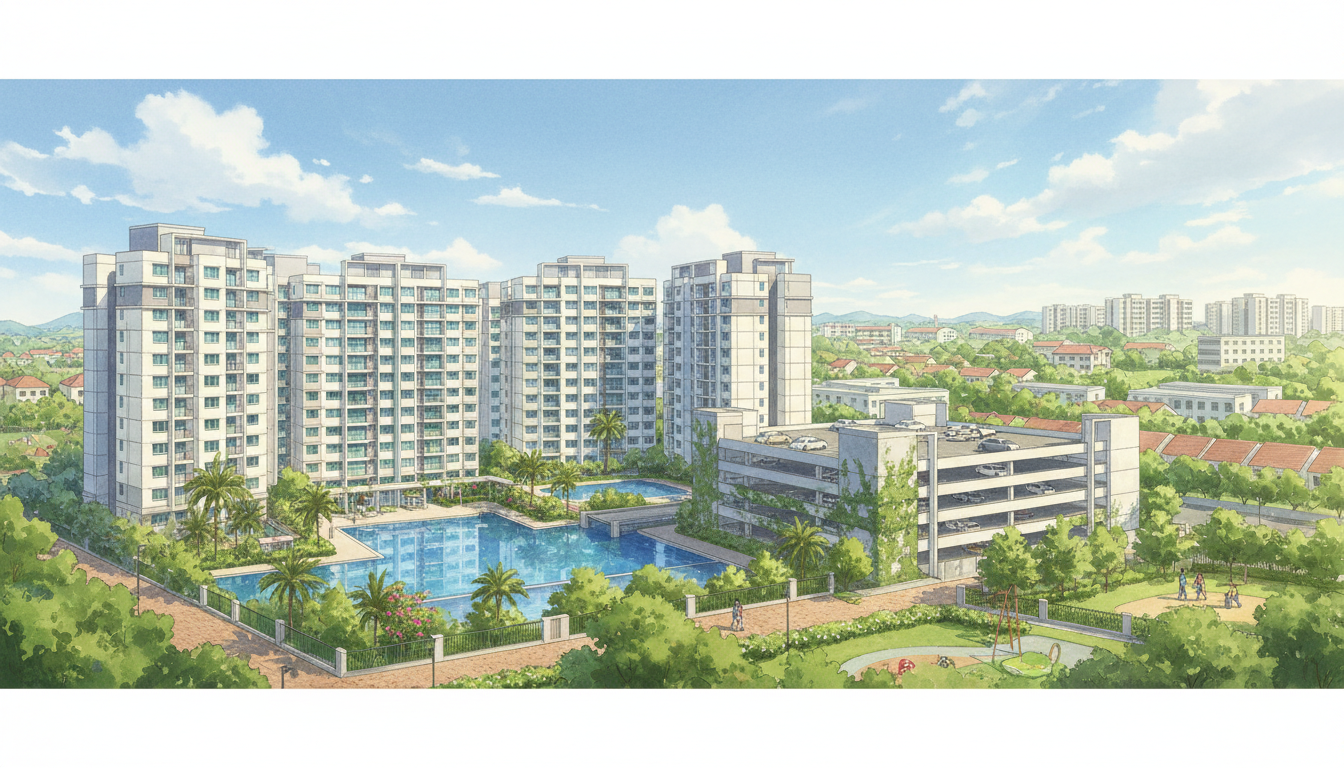
Tenet Executive Condominium (EC) at 650 Tampines Street 62 in Singapore's District 18 offers a sustainable, family-friendly living option in the mature Tampines estate. Developed by TQS Development Pte Ltd—a joint venture of Qingjian Realty, Santarli Realty Pte Ltd, and Heeton Holdings—this 99-year leasehold project with 618 units and TOP in 2026 emphasizes green design, car-lite living, and premium facilities like a 50m lap pool.
Homejourney provides this definitive guide to help you evaluate Tenet as a buyer, investor, or tenant. With verified data from official sources like URA and HDB, we prioritize transparency and user safety to support confident decisions in Singapore's property market.
Table of Contents
- Project Overview
- Unit Types and Floor Plans
- Facilities and Amenities
- Location and Accessibility
- Nearby Amenities
- Price Analysis
- Pros and Cons
- Investment Potential
- Frequently Asked Questions
Project Overview
Tenet EC stands out as a green, sustainable executive condominium in District 18, designed for modern families seeking affordability with condo-like luxury. Located at 650 Tampines Street 62, it spans a 23,799.2 sqm site with 11 blocks of 15 storeys, totaling 618 units.[1][3][5]
TQS Development Pte Ltd secured the site for $442 million ($659 psf ppr) in the GLS programme. The project promotes car-lite living with 618 parking lots (including 6 EV charging spaces), 5 accessible spots, and 104 bicycle spaces—rare for ECs which often limit basement parking.[1][5]
Key specs include 99-year leasehold from 1 November 2021, estimated TOP 2 August 2026, and plot ratio of 2.5. All blocks feature northeast or southwest orientations with point-block designs for optimal privacy and ventilation, aligning with URA's sustainable housing guidelines.[3][5]
| Project Detail | Tenet EC |
|---|---|
| Tenure | 99-year leasehold (from 1 Nov 2021) |
| Total Units | 618 |
| Blocks/Storeys | 11 blocks, 15 storeys each |
| Site Area | 23,799.2 sqm |
| TOP | 2026 |
Note: Prices and availability fluctuate; check Homejourney for latest listings via Browse available units at Tenet.
Unit Types and Floor Plans
Tenet offers 3-, 4-, and 5-bedroom units tailored for families, with sizes from 893 sqft to 1,572 sqft. These EC layouts prioritize space efficiency, natural light, and smart storage—ideal for HDB upgraders in Tampines.[1][2]
Insider tip: Higher-floor units (above 10th storey) in southwest-facing blocks catch afternoon breezes, reducing aircon reliance in humid Singapore weather. Floor plans emphasize open kitchens and balcony extensions for indoor-outdoor living.
| Unit Type | Bedrooms/Baths | Size Range (sqft) | Example PSF (2026) |
|---|---|---|---|
| 3-Bedroom | 3/2-3 | 893 - 1,098 | S$1,230 - S$1,350[1][2] |
| 4-Bedroom | 4/3-4 | 1,098 - 1,367 | S$1,260 - S$1,350[1][2] |
| 5-Bedroom | 5/4 | 1,561 - 1,572 | S$1,235 - S$1,520[1][2] |
For detailed floor plans, visit Homejourney's View comprehensive analysis of Tenet. Units include smart home pre-wiring, a nod to Singapore's digital economy push.
Layout Highlights
- Spacious living-dining areas with balcony access for family gatherings.
- En-suite bathrooms in master bedrooms; powder rooms in larger units.
- Bomb shelter storage, standard in Singapore ECs per HDB regs.
- Flexible study nooks convertible to guest rooms—perfect for WFH in post-pandemic era.
Facilities and Amenities
Tenet elevates EC living with resort-style facilities across multiple levels, including a 50m lap pool, infinity pool, gym, and clubhouse. Communal zones like meditation retreats and reflexology trails promote wellness in line with Singapore's health initiatives.[1][3]
Security is top-tier: 24-hour patrols, CCTV, and access card systems ensure resident safety—a core Homejourney value. Multi-storey and basement car parks accommodate families, with EV readiness future-proofing the development.[5]
- Swimming Pools: 50m lap pool + infinity pool.
- Fitness: Gym, tennis courts, playgrounds.
- Social: BBQ pits, private dining, entertainment rooms, library, pavilions.
- Wellness: Meditation retreat, reflexology trail.
- Security: 24/7 security, CCTV, smart access.
Local insight: The 5th-6th floor facilities minimize ground-level noise, ideal for young families. Post-move, Homejourney's aircon services keep your unit pristine.
Location and Accessibility
Nestled in Tampines—a mature new town in D18 (Tampines, Pasir Ris, Simei)—Tenet benefits from excellent connectivity. Nearest MRTs: Tampines North (CR6, ~800m, 10-min walk) and Pasir Ris (CR5). Bus stops along Tampines Street 62 link to CBD in 30-40 mins.[2][4]
Major roads: Tampines Expressway (TPE), Pan Island Expressway (PIE). Drive to CBD: ~20km, 25 mins off-peak. Proximity to Changi Airport (10-15 mins) suits frequent travellers.[1]
D18 perks: Family-oriented with low crime rates, per Singapore Police stats. Homejourney verifies transport data for accurate planning.
Accessibility Summary
| Transport | Details | Distance/Time |
|---|---|---|
| MRT | Tampines North (CR6) | ~10-min walk |
| MRT | Pasir Ris (CR5) | Short drive |
| Expressway | TPE/PIE | Direct access |
| CBD | By MRT/Bus | 30-40 mins |
Nearby Amenities
Tampines' ecosystem supports daily needs: Tampines Mall, Tampines 1 (5-10 mins walk), Giant/NTUC supermarkets. Hawker centres like Tampines Round Market offer affordable eats (S$3-5 meals).[1]
Schools: Tampines Primary (1km), St. Hilda's Primary/Secondary (within 1.5km), Ngee Ann Poly (2km). Healthcare: Tampines Polyclinic (10-min walk). Parks: Tampines Eco Green (500m) for jogs.[2]
- Shopping: Tampines Mall, IKEA Tampines.
- Schools (1-2km): 6 primaries, 4 secondaries; priority for EC residents under MOE phase.
- Dining: Pasir Ris hawker, cafes along Loyang Ave.
- Recreation: Sun Plaza Park, Bedok Reservoir (cycling).
Compare with nearby like Hundred Palms Residences Amenities: Schools, Shopping, Transport ">Hundred Palms Residences amenities for D19 insights. Explore more on Homejourney's projects directory.
Price Analysis
As of 2026, Tenet units range S$1,230-$1,520 psf, with 3-bed at ~S$1.2M, 4-bed ~S$1.5M, 5-bed ~S$1.9M. This reflects EC pricing post-MOPS (5 years from TOP), competitive vs. D18 condos.[1][2]
Trends: Stable appreciation in Tampines due to EC conversion potential after 10 years. Vs. nearby: 10-15% lower PSF than private condos like The Dewfly. Rental yields ~3.5-4% estimated, strong for investors.[1]
Disclaimer: Prices are indicative from recent transactions; consult Homejourney mortgage calculator and agents for personalized quotes. Use property search for live data.
Pros and Cons
Pros
- Prime D18 location with mature amenities and schools.
- Luxury facilities rare in ECs (50m pool, EV parking).
- Family-sized units at accessible prices.
- Sustainable design lowers utility costs.
- Strong rental demand from expats near Expo.
Cons
- 99-year leasehold vs. freehold options elsewhere.
- Developing Tampines North area may see construction till 2030.
- EC restrictions: No resale to foreigners pre-10 years.
- Competition from new ECs like Parc Canberra.
Best for: Young families upgrading from HDB, seeking space without CBD premiums. Speak to experts via Speak to a property agent about Tenet.
Investment Potential
Tenet's outlook is positive: Tampines' growth via Cross Island Line (by 2030) boosts values 10-20%. Rental demand high from airport workers, yielding 3.8% avg. Liquidity strong post-MOPS.[2][4]
Future upside: Nearby Singapore Expo expansions, Tanah Merah Country Club. Compare yields with Hundred Palms Residences Investment: Rental Yield & Growth Analysis ">Hundred Palms investment analysis. Risks: Interest rate hikes; mitigate via Homejourney financing tools.
Original insight: ECs like Tenet offer 15-25% appreciation by year 10, per URA trends in mature estates. Ideal for mid-term holds.
Frequently Asked Questions
What is the nearest MRT to Tenet EC?
Tampines North MRT (CR6) is about 800m or 10-minute walk away.[2]
What are current Tenet EC prices in 2026?
Range from S$1,230-$1,520 psf; e.g., 3-bed ~S$1,100,000. Verify on Homejourney.[1][2]
Is Tenet EC suitable for families with kids?
Yes—proximity to 6 primary schools within 1-2km, playgrounds, and parks. MOE school balloting applies.[1]
When can I buy Tenet as a private condo?
After 10 years from TOP (2036), open to all including foreigners.
What facilities does Tenet have?
50m lap pool, infinity pool, gym, BBQ, meditation areas, 618 parking lots.[3][5]
How does Tenet compare to nearby condos?
More affordable (10-15% lower PSF) with better family facilities, but leasehold.
Ready to explore Tenet? Start with Homejourney's property search, financing via bank rates, or connect with agents. We verify listings for your safety, building trust every step of your journey.