856 Tampines Street 82 HDB For Sale: Complete Resale Buyer's Guide
Finding the right HDB resale flat in Singapore requires understanding not just the property itself, but the entire ecosystem of regulations, financing options, and market dynamics. Block 856 Tampines Street 82 represents a significant opportunity in Singapore's mature residential landscape, offering established amenities, proven community infrastructure, and accessible pricing for first-time buyers and investors alike. This comprehensive guide from Homejourney will walk you through everything you need to know about purchasing a resale flat at this location, from market pricing to financing strategies to post-purchase considerations.
Table of Contents
- Executive Summary: 856 Tampines Street 82 at a Glance
- Location Profile & Neighbourhood Character
- Property Specifications & Unit Types
- Current Market Pricing & Transaction Trends
- HDB Resale Financing: CPF & Mortgage Guide
- Step-by-Step Resale Buying Process
- Investment Analysis & Rental Potential
- Lifestyle & Community Amenities
- Decision-Making Framework for Buyers
- Common Mistakes to Avoid
- Frequently Asked Questions
- Next Steps & Homejourney Support
Executive Summary: 856 Tampines Street 82 at a Glance
Block 856 Tampines Street 82 is a mature HDB development completed in 1986, located in the Tampines planning area (District 18) with a 99-year leasehold tenure. The block comprises 11 storeys and offers multiple unit types ranging from 2-room to 5-room configurations, with sizes spanning from approximately 904 square feet to 1,582 square feet. Recent resale transactions show prices ranging from S$520,888 to S$750,000, with price per square foot (psf) ranging from S$571 to S$605 psf depending on unit type and condition.
The block's proximity to Tampines West MRT station makes it particularly attractive for commuters, while the established Tampines neighbourhood provides mature amenities including shopping centres, hawker complexes, and educational institutions. For buyers evaluating this property through Homejourney's trusted platform, understanding the specific characteristics of this block and the current market context is essential for making an informed purchasing decision.
Key Property Metrics
| Property Address | 856 Tampines Street 82, Singapore 520856 |
| Postal Code | 520856 |
| Built Year | 1986 |
| Tenure | 99 Years |
| Number of Storeys | 11 |
| Nearest MRT | Tampines West MRT Station |
| Planning District | D18 (Tampines) |
| Current Price Range | S$520,888 - S$750,000 |
| Price Per Sqft Range | S$571 - S$605 psf |
Location Profile & Neighbourhood Character
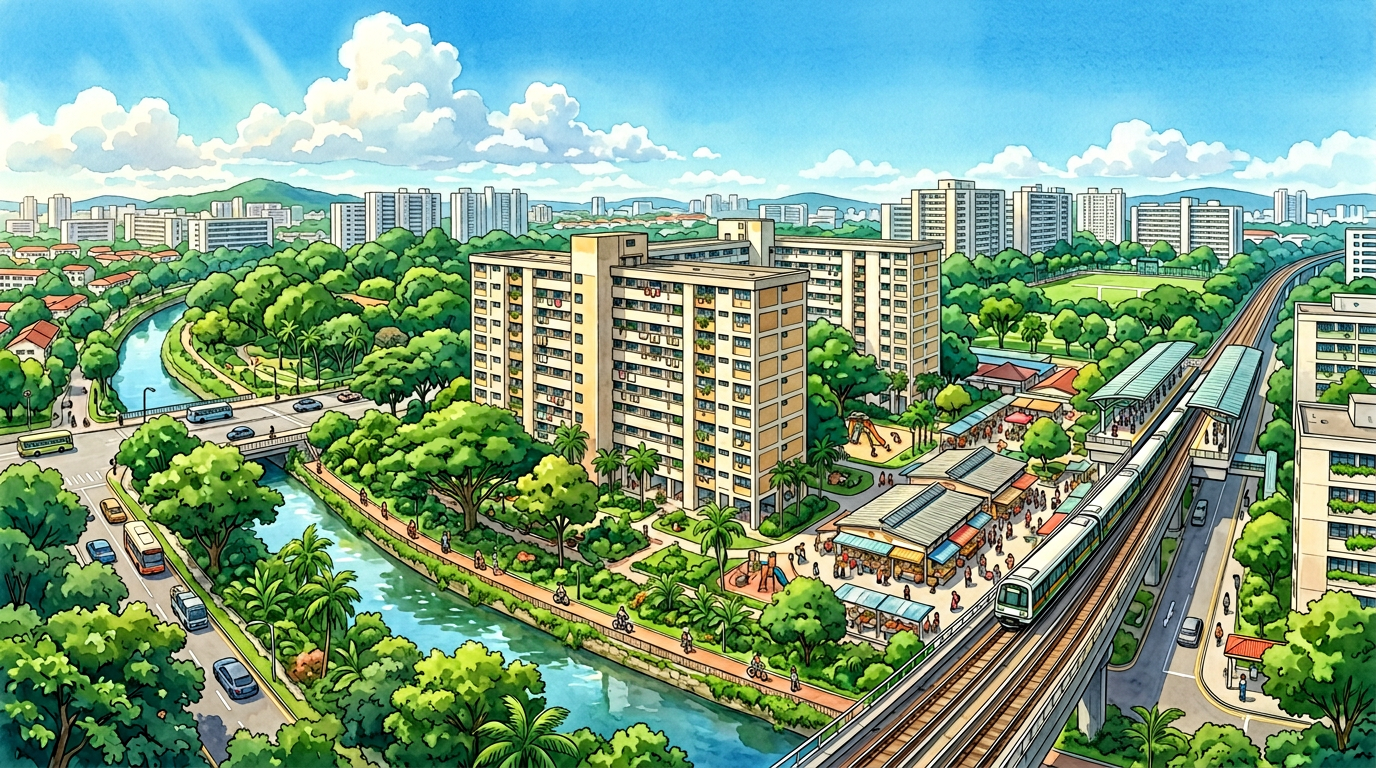
Tampines is one of Singapore's largest and most established residential towns, developed as a planned new town in the 1980s. Block 856 sits within the Tampines Ville precinct, a mature cluster of HDB blocks that has evolved into a well-integrated residential community. The neighbourhood's maturity is both an advantage and a consideration for buyers—while amenities are well-established and the community is settled, the area lacks the newer developments and cutting-edge facilities found in more recent housing estates.
Transport Connectivity
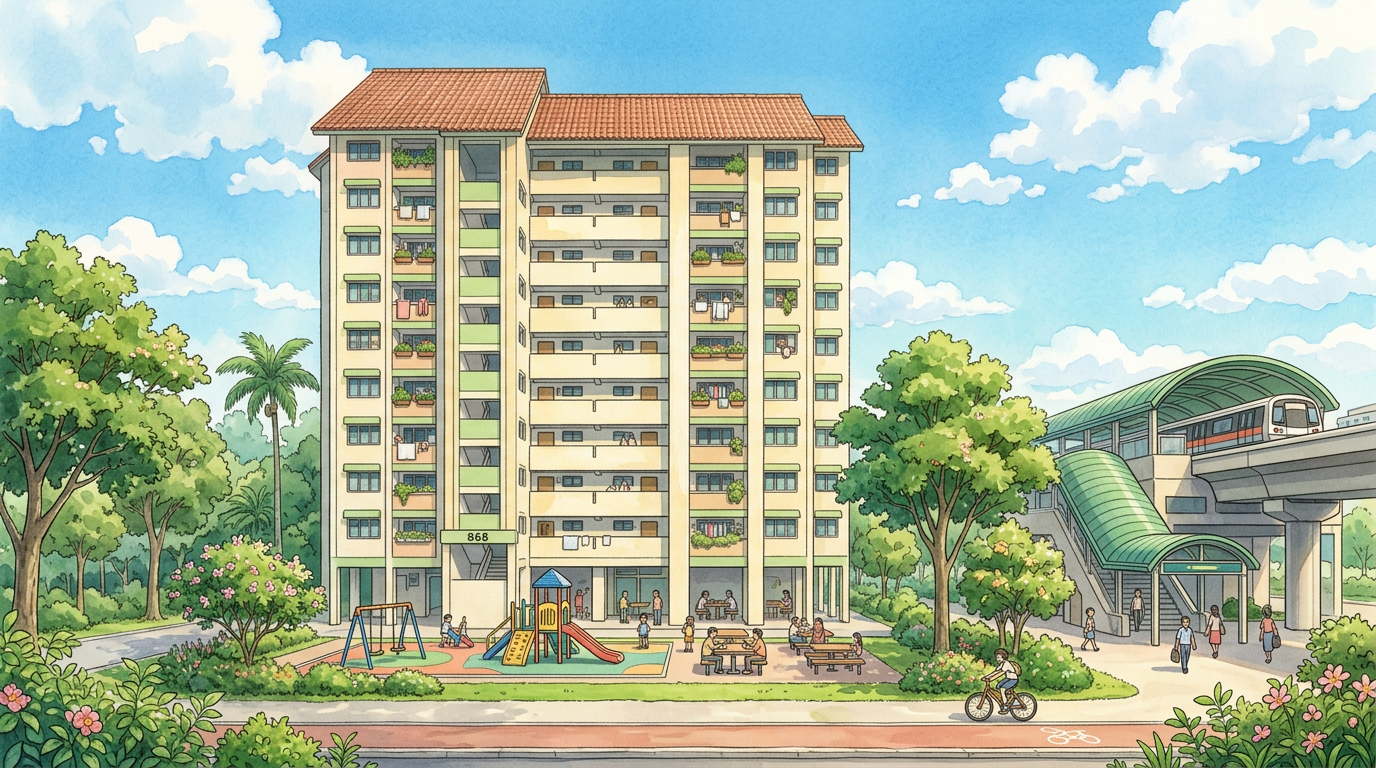
The proximity to Tampines West MRT station is a significant advantage for this block. Located on the Circle Line (CCL), Tampines West MRT provides direct access to the CBD, making commuting to the central business district straightforward. The station is approximately a 10-15 minute walk from Block 856, positioning it as highly accessible for working professionals. The Circle Line connection also provides interchange opportunities at various stations, expanding travel options across Singapore's public transport network.
Retail & Dining Options
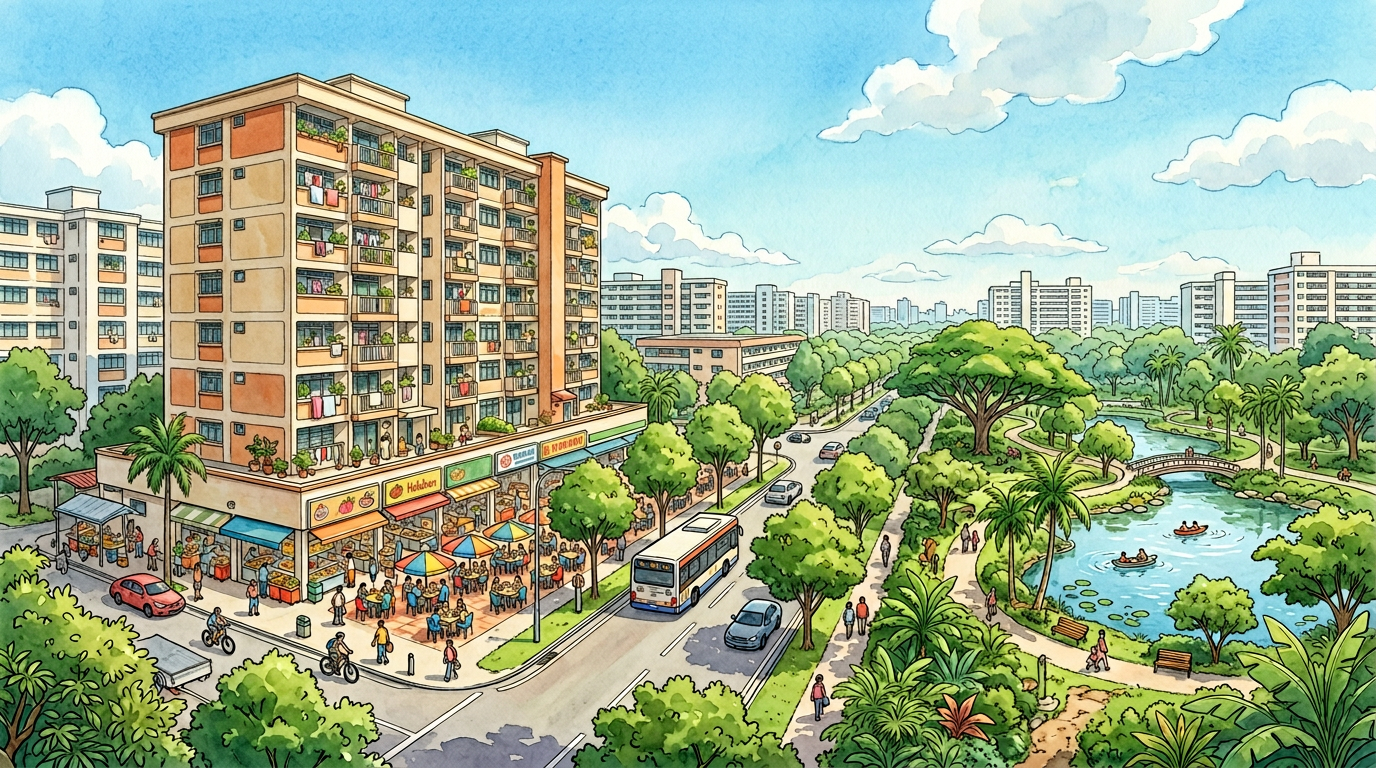
The Tampines area is well-served by shopping centres and dining establishments. Tampines Mall, Tampines 1, and other retail outlets provide diverse shopping and entertainment options. The neighbourhood also features multiple hawker centres offering authentic local cuisine at affordable prices, a key consideration for families and budget-conscious residents. These mature amenities contribute to the neighbourhood's appeal as a complete residential destination.
Educational Institutions
Tampines hosts several primary and secondary schools, making it attractive for families with school-age children. The established education infrastructure means parents have multiple options for their children's schooling, with schools within reasonable proximity to the block. This is an important consideration for families prioritising educational access when selecting a residential location.
Property Specifications & Unit Types
Block 856 Tampines Street 82 offers multiple unit configurations to accommodate different household sizes and preferences. Understanding the specific characteristics of each unit type is crucial for determining which option best suits your needs and budget.
Unit Types & Sizes
The block contains 2-room, 3-room, 4-room, and 5-room units, with total floor areas ranging from 904 square feet (approximately 84 square metres) for smaller units to 1,582 square feet (approximately 147 square metres) for the largest units. The 3-room units, typically around 84 square metres, represent the most common configuration in this block and are popular among first-time buyers and small families. 4-room and 5-room units cater to larger families and investors seeking higher rental income potential.
HDB Model Specifications
| Unit Type | Approximate Size (sqft) | Approximate Size (sqm) | Bedrooms | Typical Use |
| 2-Room | ~550-600 | ~51-56 | 2 | Couples, elderly |
| 3-Room | ~904 | ~84 | 3 | First-time buyers, small families |
| 4-Room | ~1,200-1,300 | ~111-121 | 4 | Growing families, investors |
| 5-Room | ~1,400-1,582 | ~130-147 | 5 | Large families, premium investors |
Building Age & Maintenance Considerations
As a 40-year-old development (built in 1986), Block 856 is classified as a mature HDB block. While the structure remains sound, prospective buyers should be aware that older buildings may require more frequent maintenance and eventual major upgrading works. The Housing & Development Board periodically conducts structural assessments and may implement improvement programmes. When evaluating a specific unit, it's wise to inquire about any planned maintenance works or recent renovations that might affect the property's condition and value.
Current Market Pricing & Transaction Trends
Understanding the pricing landscape for 856 Tampines Street 82 is essential for making a competitive offer and assessing whether a property represents fair value. Recent market data reveals important trends in how prices vary by unit type, floor level, and condition.
Recent Transaction Analysis
Recent resale transactions at Block 856 show considerable variation based on unit type and size. 3-room units have recently transacted in the S$520,000-S$522,000 range, translating to approximately S$571-S$605 per square foot. 5-room units command significantly higher prices, with recent transactions recorded at S$738,000-S$750,000, reflecting the premium for larger living spaces and additional bedrooms. This pricing structure reflects fundamental market dynamics where larger units attract both family buyers and investors seeking higher rental income.
Price Per Square Foot (PSF) Analysis
The price per square foot metric is crucial for comparing value across different unit types and locations. At Block 856, the psf range of S$571-S$605 is competitive within the Tampines market for mature HDB developments. This metric allows buyers to standardise pricing across different unit sizes—a 3-room unit at S$522,000 (84 sqm) represents approximately S$605 psf, while a 5-room unit at S$750,000 (122 sqm) represents approximately S$614 psf, showing relatively consistent pricing logic across unit types.
Rental Market Insights
For investors evaluating Block 856 as an investment property, understanding the rental market is critical. Recent rental transactions show monthly rates ranging from S$2,500 to S$4,000 depending on unit type and condition. A 5-room unit renting for S$3,500-S$4,000 monthly on a property purchased for S$750,000 represents a gross rental yield of approximately 5.6%-6.4% annually—a reasonable return for a mature HDB property in an established neighbourhood. These rental rates reflect steady demand from professionals and families seeking accommodation in the Tampines area.
HDB Resale Financing: CPF & Mortgage Guide
For most buyers, financing represents the most complex aspect of purchasing an HDB resale flat. Singapore's unique system combining CPF (Central Provident Fund) usage with mortgage financing requires careful planning and understanding of eligibility criteria, contribution limits, and repayment obligations.
CPF Usage for HDB Resale Purchase
The CPF Ordinary Account (OA) can be used to purchase HDB resale flats, providing a significant advantage over cash purchases by allowing buyers to leverage their retirement savings. CPF funds can be used for the following purposes: (1) down payment on the property, (2) monthly mortgage payments, and (3) stamp duties and other transaction costs. However, strict rules govern CPF usage—you must be at least 21 years old, have sufficient CPF balance, and meet citizenship requirements (Singapore citizen or permanent resident).
The maximum CPF withdrawal is limited to the purchase price of the property or the valuation of the property, whichever is lower. This means if you're purchasing a unit at S$600,000 but the HDB valuation comes in at S$580,000, your CPF withdrawal limit is S$580,000. Additionally, after using CPF for the purchase, you must maintain a minimum CPF balance of S$20,000 in your OA (or S$40,000 if you're above 55 years old), which cannot be withdrawn.
Mortgage Financing Options
Most HDB resale buyers combine CPF with a mortgage loan from a bank or HDB itself. The HDB Housing Loan offers competitive rates and is specifically designed for HDB purchases, while bank mortgages provide flexibility and potentially better rates for qualified borrowers. When evaluating financing options through Homejourney's Bank Rates resource, compare the following key factors:
- Interest rates: Compare current rates across multiple lenders; even 0.1-0.2% differences translate to significant savings over a 25-30 year loan period
- Lock-in periods: Understand any restrictions on early repayment or refinancing
- Processing fees: Factor in loan origination fees, valuation fees, and legal fees
- Loan tenure: HDB loans typically offer up to 25 years; bank loans may offer 30 years
- Flexibility: Consider whether you need flexibility for early repayment or refinancing
Loan-to-Value (LTV) & Debt Servicing Limits
Singapore's prudential regulations impose strict limits on how much you can borrow relative to the property's value. The Loan-to-Value (LTV) limit for HDB resale purchases is typically 80%, meaning if your property is valued at S$600,000, you can borrow a maximum of S$480,000. Additionally, the Total Debt Servicing Ratio (TDSR) limit of 60% restricts total monthly debt obligations (including mortgage, car loans, credit cards, and other liabilities) to no more than 60% of your gross monthly income.
For a buyer with a gross monthly income of S$6,000, the maximum total monthly debt servicing is S$3,600. If you already have S$500 in monthly car loan payments, your maximum mortgage payment capacity is S$3,100. This calculation is crucial—many buyers underestimate their true borrowing capacity when they have existing debts. Homejourney recommends calculating your actual TDSR capacity before house hunting to avoid disappointment when loan applications are rejected.
Calculating Your Affordability
To determine how much you can realistically afford at Block 856 or similar properties, work through this framework: (1) Calculate your CPF OA balance available for purchase (minus the S$20,000 minimum); (2) Determine your maximum loan amount based on LTV limits (80% of valuation); (3) Calculate your maximum monthly mortgage payment based on TDSR limits; (4) Use a mortgage calculator to determine the loan amount that fits your monthly payment capacity; (5) Add your CPF down payment to your maximum loan amount to determine total purchase price capacity.
For example, if you have S$120,000 in CPF OA available, can borrow S$480,000 (80% LTV on a S$600,000 property), and your TDSR allows S$2,500 monthly mortgage payments, your total purchasing power is approximately S$600,000. This framework ensures you're not over-extending financially and maintains a sustainable debt servicing ratio.
Step-by-Step Resale Buying Process
The HDB resale process in Singapore involves multiple stages, each with specific requirements, timelines, and costs. Understanding this process prevents surprises and ensures smooth transaction completion.
Stage 1: Pre-Purchase Planning (Weeks 1-2)
Before viewing properties or making offers, complete your financial groundwork. Obtain your CPF balance statement from the CPF Board website, get a mortgage pre-approval from your chosen lender to understand your borrowing capacity, and arrange for a property inspection specialist if you want professional assessment of the unit's condition. Having these elements in place accelerates the purchase process once you've identified a suitable property.
Stage 2: Property Identification & Viewing (Weeks 2-4)
Search for available units at Block 856 through Homejourney's Property Search platform, which provides comprehensive listings, recent transaction data, and neighbourhood information. When viewing units, inspect the condition carefully—check for water seepage, cracks, plumbing functionality, electrical outlets, and overall maintenance. For a 40-year-old building, these inspections are particularly important. Request the seller's disclosure form (Form 4) which details any known defects or issues with the property.
Stage 3: Offer & Negotiation (Weeks 4-6)
Once you've identified a suitable unit, submit a written offer through your agent or directly to the seller. The offer should specify the purchase price, proposed completion date, and any conditions (such as subject to mortgage approval or satisfactory inspection). Negotiations may take several weeks as seller and buyer align on price and terms. Be prepared to walk away if the asking price significantly exceeds market comparables—patience often yields better outcomes in property transactions.
Stage 4: Legal & Financial Arrangements (Weeks 6-10)
Once an offer is accepted, engage a conveyancing lawyer to handle legal documentation and HDB procedures. Your lawyer will conduct searches on the property, verify the seller's ownership, and prepare the necessary legal documents. Simultaneously, finalise your mortgage application with your lender. The lender will conduct a property valuation—if the valuation is lower than your agreed purchase price, your borrowing capacity may be reduced, potentially requiring additional CPF funds or renegotiation of the purchase price.
Stage 5: HDB Approval & Completion (Weeks 10-14)
Your lawyer submits the purchase documents to HDB for approval. HDB typically processes applications within 4-6 weeks. Once approved, you'll receive notification to proceed to completion. At completion, you pay the balance of the purchase price (using CPF and/or mortgage funds), sign final documents, and receive the keys. The entire process from offer acceptance to completion typically takes 8-12 weeks, though timelines vary based on HDB processing speed and lender responsiveness.
Required Documents Checklist
- NRIC (National Registration Identity Card) or passport
- CPF statement and CPF withdrawal form
- Mortgage pre-approval letter from lender
- Recent payslips (typically 3 months) and tax returns (last 2 years)
- Bank statements (typically 3-6 months)
- HDB Form 4 (Property Disclosure Form) from seller
- Latest property tax assessment
- Building plan and floor plan
- Proof of citizenship or permanent residency
- Marriage certificate (if applicable) and spouse's NRIC
Investment Analysis & Rental Potential
For investors evaluating Block 856 Tampines Street 82 as an investment property, several financial metrics and market considerations determine whether it represents a sound investment decision.
Gross Rental Yield Calculation
Gross rental yield is calculated as (annual rental income ÷ property purchase price) × 100. For a 5-room unit purchased at S$750,000 and renting for S$3,800 monthly (S$45,600 annually), the gross rental yield is 6.08%. This exceeds the typical 4-5% yield for many Singapore properties, making Block 856 attractive for yield-focused investors. However, gross yield doesn't account for expenses—property tax, maintenance, and potential vacancy periods reduce net returns to approximately 4-5% after expenses.
Capital Appreciation Prospects
HDB resale flats, particularly in mature estates, typically appreciate more slowly than private properties. Historical data suggests mature HDB properties appreciate at 2-3% annually, though this varies based on location, renovation, and broader market conditions. Block 856's established location in Tampines with MRT access provides reasonable appreciation potential, but investors shouldn't expect the dramatic capital gains possible with newer developments or prime locations. The investment case for Block 856 rests primarily on steady rental income rather than capital appreciation.
Risk Considerations for Investors
Several risk factors warrant consideration: (1) Lease decay—as the 99-year lease approaches expiration (currently 60 years remaining), property values may decline; (2) Major upgrading works—HDB may implement costly improvement programmes requiring significant resident contributions; (3) Rental market saturation—oversupply of rental units in Tampines could pressure rental rates downward; (4) Interest rate risk—if you're financing with a floating-rate mortgage, rising rates increase debt servicing costs; (5) Regulatory changes—HDB policies or cooling measures could affect investment returns.
Investor Decision Framework
Evaluate Block 856 as an investment using this framework: (1) Calculate total investment required (down payment + closing costs); (2) Project annual rental income based on current market rates; (3) Estimate annual expenses (property tax, maintenance, insurance, potential vacancy); (4) Calculate net annual return; (5) Compare against alternative investments (stocks, bonds, other properties); (6) Assess risk tolerance and investment horizon; (7) Evaluate whether the property fits your overall portfolio strategy.
Lifestyle & Community Amenities
Beyond financial considerations, the quality of life in your chosen neighbourhood significantly impacts long-term satisfaction with your property purchase. Block 856's location in Tampines provides access to diverse amenities supporting daily living and recreation.
Shopping & Retail Facilities
Tampines hosts multiple shopping destinations within reasonable distance. Tampines Mall, located along Tampines Avenue 4, offers diverse retail options, dining establishments, and entertainment facilities. Tampines 1, another major shopping centre, provides additional retail and F&B options. For everyday groceries and necessities, multiple supermarkets and wet markets serve the neighbourhood. The mature retail infrastructure means residents enjoy abundant shopping choices without needing to travel to other areas.
Dining & Food Culture
The Tampines area features numerous hawker centres offering authentic local cuisine at affordable prices. These establishments serve traditional Chinese, Malay, and Indian dishes, providing residents with diverse dining options. Multiple restaurants and cafes cater to different budgets and preferences. This mature food culture is a significant lifestyle advantage, particularly for families and those who value convenient access to diverse cuisine.
Parks & Recreation
Tampines Green is a major recreational facility offering jogging tracks, cycling paths, and open spaces for community activities. The neighbourhood also features multiple smaller parks and fitness corners. For families with children, playgrounds and community centres provide recreational opportunities. The mature estate's recreational infrastructure supports active, healthy lifestyles.
Healthcare Facilities
Tampines hosts polyclinics and private medical clinics serving residents' healthcare needs. The proximity to established healthcare infrastructure is particularly important for families with young children or elderly residents requiring regular medical attention.
Community & Social Infrastructure
As a mature estate, Tampines has well-established community centres, grassroots organisations, and social networks. These institutions organise community activities, support services for residents, and social programmes that foster neighbourhood cohesion. For residents valuing community engagement and social connections, Tampines' mature social infrastructure provides meaningful opportunities.
Decision-Making Framework for Buyers
Deciding whether to purchase at Block 856 Tampines Street 82 requires evaluating multiple dimensions beyond price. This framework helps structure your decision-making process.
Key Decision Factors
| Decision Factor | Questions to Consider | Block 856 Assessment |
| Location Fit | Does the location match your work commute, family needs, and lifestyle preferences? | Tampines West MRT provides good CBD access; mature amenities suit families; established neighbourhood |
| Financial Capacity | Can you afford the purchase price, financing costs, and ongoing expenses? | S$520K-S$750K range suits various budgets; competitive psf pricing; manageable financing |
| Unit Type Match | Does the available unit type (2/3/4/5-room) suit your household size and future needs? | Multiple unit types available; 3-room suits first-timers; 5-room suits growing families |
| Property Condition | Is the specific unit in good condition? Will major repairs be needed soon? | 40-year-old building; inspect carefully; inquire about planned maintenance |
| Investment Potential |