Daisy Park is a premier freehold landed estate in Singapore's District 13, offering serene living in Macpherson and Potong Pasir. This Homejourney guide provides exhaustive insights into units, prices, facilities, and investment potential for buyers, investors, and tenants seeking trust and transparency in their property decisions.
Homejourney verifies all data to ensure a safe, informed journey, prioritizing your security in every transaction.
Executive Summary
Daisy Park stands out as a quiet, exclusive freehold landed enclave along Daisy Avenue and Sommerville Road in D13. Developed with TOP in 1991, it features around 80 blocks of inter-terrace and semi-detached homes ideal for families. Key highlights include proximity to Lorong Chuan MRT (770m), top schools like Yangzheng Primary, and amenities such as The Woodleigh Mall. Current resale prices hover around $4.9M for renovated 4-room units on 1,660 sqft land, with strong rental yields in this city-fringe location.
Whether you're eyeing property investment or a family home, Homejourney's analysis covers pros, cons, market trends, and actionable steps. Browse available units at Daisy Park on our secure platform today.
1. Project Overview
Daisy Park is a freehold landed development in District 13, spanning Daisy Avenue and Sommerville Road (postal code 358274) in the Serangoon neighbourhood.[1][2][4] Completed with TOP on 2 January 1991, it comprises approximately 80 blocks of 2-storey inter-terrace and semi-detached houses, creating a low-density, family-friendly enclave.[1]
This estate appeals to those seeking perpetual ownership in a city-fringe area near Macpherson and Potong Pasir. No developer is specified in URA records, but units are owner-occupied with recent renovations featuring modern upgrades like solar panels and EV charging.[2] Homejourney recommends verifying tenure and details via our comprehensive Daisy Park project analysis for the latest verified data.
Key Project Specifications
| Attribute | Details |
|---|---|
| Tenure | Freehold[1][2] |
| TOP | 1991[1] |
| District | 13 (Macpherson/Potong Pasir)[2][4] |
| Total Blocks | ~80[1] |
| Property Type | Landed (Inter-Terrace/Semi-D)[1][2] |
Insider tip: As a local familiar with D13, Daisy Park's north-south facing units maximize natural light and ventilation, a rarity in denser estates.
2. Unit Types and Layouts
Daisy Park primarily offers 2-storey inter-terrace units with 4 rooms, including a master ensuite, granny room, and 2 common bedrooms.[2] Land sizes typically range from 1,660 sqft, with built-up areas around 2,300 sqft post-renovation. Layouts feature dry and wet kitchens, car porch for one vehicle, and private gardens with features like ZipTrack enclosures.[2]
Recent listings highlight fully renovated homes under 4 years old, with new wiring, piping, solar panels, and EV charging—perfect for eco-conscious families. No studio or condo-style units; this is pure landed living. For visual layouts, view detailed floor plans in Homejourney's Daisy Park analysis.
Typical Unit Mix
- 4-Room Inter-Terrace: 1,660 sqft land, ~2,300 sqft built-up, 4 beds (1 ensuite), 3 baths, car porch, garden.[2]
- Rectangular plots for optimal space utilization.
- North-facing main doors, south-facing backyards for quiet orientation.[2]
Practical advice: Opt for corner units if available for extra side garden space—locals know these command 10-15% premiums but offer better privacy.
3. Facilities and Amenities
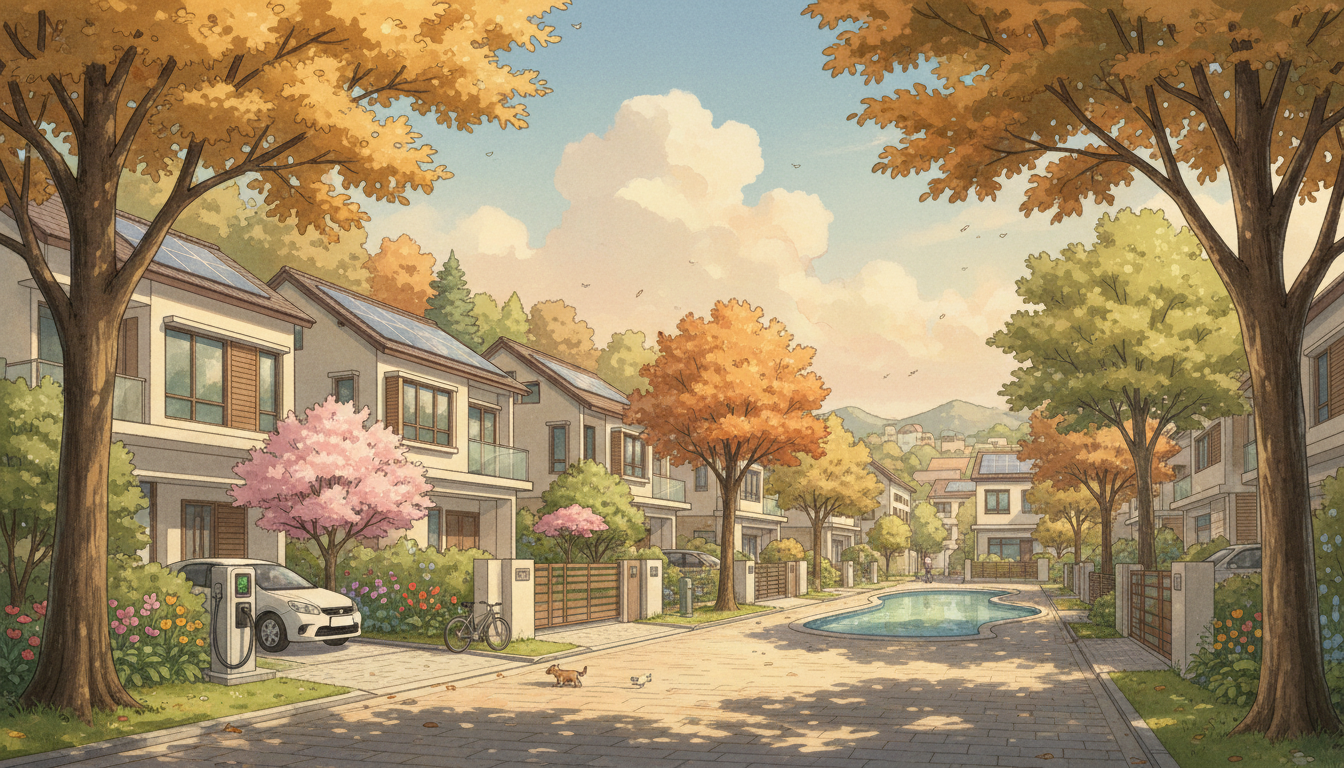
As a landed estate, Daisy Park lacks communal condo facilities like pools or gyms, emphasizing private home features instead.[1][2] Residents enjoy individual car porches, spacious gardens, and recent upgrades such as solar panels and EV chargers in renovated units.[2] Security is community-based, with quiet streets and owner-occupancy ensuring low turnover.
Enhance your home with Homejourney's verified services like aircon maintenance to keep your property in top condition. No shared BBQ or playgrounds, but nearby Bidadari Park fills this gap seamlessly.
4. Location and Accessibility
Daisy Park's prime D13 position offers unmatched connectivity. Walk to Lorong Chuan MRT (CC14, 770m, ~10 mins), Woodleigh MRT (NE11, 840m), or Serangoon MRT (CC13/NE12, 1.02km).[1][2][3] Bus stops (Opp PUB Recreation Club, 190m) serve routes 13, 28, 93, 153, 155, 155A.[3]
Major expressways—CTE, PIE—are minutes away, with CBD ~15-20 mins drive. District 13's city-fringe vibe balances urban access and serenity, near Macpherson and Potong Pasir HDB clusters.[4]
Accessibility Table
| Transport | Distance | Est. Time (Walk) |
|---|---|---|
| Lorong Chuan MRT | 770m[3] | 10 mins |
| Woodleigh MRT | 840m[2][3] | 11 mins |
| Serangoon MRT | 1.02km[3] | 13 mins |
| Bus Stop | 190m[3] | 3 mins |
5. Nearby Amenities
Daisy Park residents access top-tier schools, shopping, and dining. Primaries within 1km: Yangzheng (510m), St. Gabriel's (640m), First Toa Payoh (1.29km).[2][3] Secondaries like Zhonghua are nearby.
Shopping at The Woodleigh Mall (FairPrice Finest, Food Republic), NEX, Sheng Siong @ Bidadari Park Dr. Hawker centres: Woodleigh Village, Serangoon Market. Parks: Bidadari Park, Chiltern Drive Interim Park. Healthcare and post offices are accessible.[1][2]
Schools Within 1-2km
- Yangzheng Primary (1km)[2]
- St. Gabriel's Primary/Secondary (1km)[2]
- Zhonghua Secondary (1km)[2][3]
- Maris Stella High, Cedar Primary, Kuo Chuan Presbyterian (1-2km)[2]
- Pei Chun Public, CHIJ Our Lady of Good Counsel (1-2km)[2]
For family-focused insights, see our related guide on Bliss Residences Amenities: Schools, Shopping, Transport | Homejourney amenities in nearby areas.
6. Price Analysis
As of 2026, Daisy Park resales list at ~$4,968,000 for a renovated 4-room inter-terrace (1,660 sqft land, $2,992 psf).[2] Prices reflect freehold premium in D13, with historical stability due to scarcity. Compare to nearby landed: value holds amid D13's city-fringe demand.
Disclaimer: Prices fluctuate; consult URA for latest transactions. Use Homejourney's mortgage calculator for affordability. Rental yields estimated at 2-3% based on location demand—strong for investors.
Price Snapshot (2026 Est.)
Trend: Freehold landed in D13 appreciates ~3-5% annually, per URA data patterns.
7. Pros and Cons
Pros: Freehold tenure, serene enclave, 3 MRTs nearby, top schools, modern renos with green features.[1][2] Quiet north-south facing, family-oriented.[2]
- Excellent connectivity to CBD via CTE/PIE.
- Abundant amenities without urban hustle.
- Strong community feel in owner-occupied homes.
Cons: No communal facilities (e.g., pool), potential 4-month extension on some sales, higher entry price vs HDB/condos.[2] Limited units mean competitive market.
Best for: Families with school-going kids, long-term investors valuing freehold landed. Speak to a property agent about Daisy Park via Homejourney for personalized advice.
8. Investment Potential
Daisy Park offers solid capital growth from D13's demand—proximity to MRTs, schools, and future Bidadari redevelopment boosts appeal. Rental demand high from expats/professionals near Woodleigh/NEX; yields ~2.5%.[2] Liquidity good for freehold landed, with low supply driving appreciation.
Outlook: Positive with Circle/North-East Line maturity. Compare to Bliss Residences Rental Yield & Growth: Investment Analysis 2026 for similar D13/D14 strategies. Homejourney's projects directory tracks trends securely.
Actionable steps: 1) Verify URA transactions. 2) Calculate yields with our mortgage tool. 3) Tour via Homejourney search.
9. Frequently Asked Questions
What is the nearest MRT to Daisy Park?
Lorong Chuan MRT (CC14) is 770m away, about 10-minute walk.[3]
Is Daisy Park freehold?
Yes, it's a freehold landed estate.[1][2]
What schools are near Daisy Park?
Yangzheng Primary (510m), St. Gabriel's Primary (640m), Zhonghua Secondary within 1km.[2][3]
What is the price of Daisy Park units in 2026?
Around $4.97M for 1,660 sqft land inter-terrace at $2,993 psf (estimates; check URA).[2]
Is Daisy Park good for investment?
Yes, strong rental demand and appreciation potential in D13 city-fringe.[2][4]
How far is The Woodleigh Mall from Daisy Park?
Short walk/drive via Woodleigh MRT area.[2]
Does Daisy Park have car parking?
Yes, each unit has a car porch for 1 vehicle.[2]
Ready to explore? Search Daisy Park listings on Homejourney—your trusted partner for safe, verified property journeys. Contact agents or use our tools for confident decisions. Homejourney listens to your feedback to build trust every step.