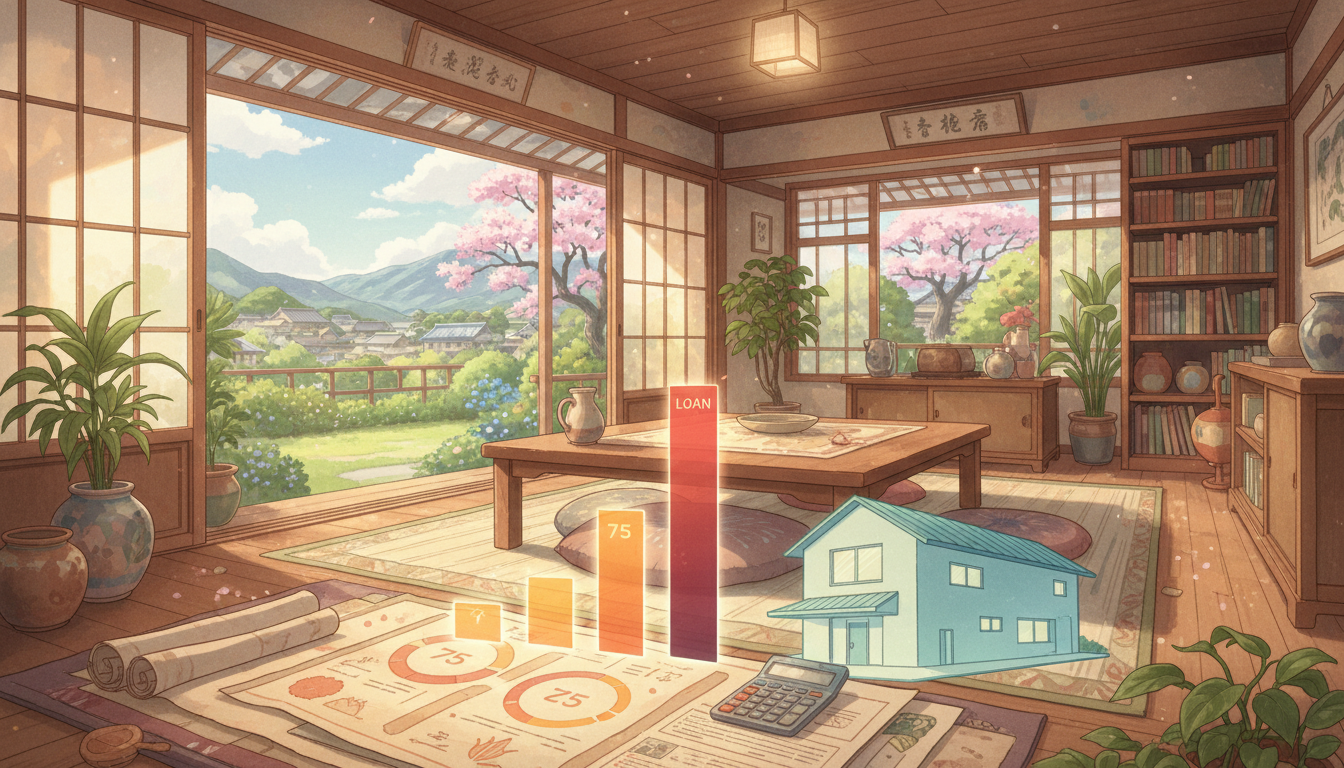
LTV Ratio Singapore Explained: Limits & Why It Matters | Homejourney
The Loan-to-Value (LTV) ratio is the maximum percentage of a property's value or purchase price (whichever is lower) that you can borrow from a bank or HDB in Singapore. Set by the Monetary Authority of Singapore (MAS), it determines your down payment requirements and prevents over-leveraging, ensuring a safe property market.
Homejourney prioritizes your safety by verifying LTV rules and providing transparent tools like our bank rates comparison at https://www.homejourney.sg/bank-rates to help you make confident decisions.
What is Loan-to-Value (LTV) Ratio in Singapore?
The LTV ratio Singapore is calculated as (Loan Amount / Property Value or Purchase Price, whichever lower) × 100%. For example, on a $1,000,000 condo valued at $1,000,000, a 75% LTV allows borrowing up to $750,000, requiring a 25% downpayment.
As of August 2024, MAS lowered HDB concessionary loan LTV to 75% (25% downpayment), while bank loans remain at 75% max for first properties. This applies to HDB flats, condos, and private properties, with the loan based on the lower of valuation or price.
Understanding property loan percentage limits helps first-time buyers like those eyeing BTO flats in Punggol or resale HDBs in Toa Payoh plan their CPF and cash needs accurately.
Current LTV Limits Set by MAS (2026)
MAS enforces LTV limits MAS to cool the market. Here's the breakdown for individual borrowers:
| Housing Loans | LTV Limit (Bank Loan) | LTV Limit (HDB Loan) | Min Cash Downpayment |
|---|---|---|---|
| 1st Property | 75% or 55%* | 75% | 5-10% |
| 2nd Property | 45% or 25%* | N/A | 25% |
| 3rd & Onwards | 35% or 15%* | N/A | 25% |
*55%/25%/15% if loan tenure >30 years (private) or >25 years (HDB), or extends past age 65. HDB loans require staggered payments: 5% upfront cash, rest CPF/cash.
Use Homejourney's eligibility calculator at https://www.homejourney.sg/bank-rates#calculator to check your loan to value instantly with Singpass integration.
Why LTV Ratio Matters for Singapore Property Buyers
LTV ratio Singapore directly impacts affordability. Higher LTV means lower upfront cash—crucial for HDB upgraders using CPF Ordinary Account (OA) savings. But lower LTV for second properties protects against debt bubbles, as seen in past cooling measures.
For a $800,000 Toa Payoh resale HDB, 75% LTV bank loan = $600,000 loan ($40,000 cash min + CPF). Exceeding limits? Banks like DBS, OCBC, UOB assess TDSR (55% max debt-to-income) alongside.
Insider tip: Valuation gaps hurt—e.g., $900k purchase but $850k valuation caps loan at 75% of $850k. Homejourney verifies data for trust.
Factors Affecting Your LTV Limit
- Existing Loans: Zero loans = max LTV; 1 loan drops to 45%; 2+ to 35%.
- Age & Tenure: Loans past 65 or >30/35 years reduce LTV to 55%.
- Property Type: HDB vs private; new launches use purchase price.
- Borrower Type: Shell companies limited to 15%.
Real example: 40-year-old buying second condo—45% LTV means 55% downpayment on $1.5M property ($825k cash/CPF). Compare rates from DBS, OCBC, UOB, HSBC at https://www.homejourney.sg/bank-rates.
HDB vs Bank Loans: LTV Differences
HDB loans (75% LTV) suit BTO buyers with MSR (30% income cap), no cash beyond 5% initial. Bank loans (75% max) offer flexibility but tie to TDSR and require 5% cash minimum.
Refinancers: Existing loan holders face lower LTV. Use Homejourney's multi-bank submission for offers from Standard Chartered, Maybank, CIMB—apply once via Singpass.
The chart below shows recent interest rate trends in Singapore:
As seen, SORA fluctuations affect monthly payments under high-LTV loans—track live on Homejourney.
How to Calculate Your LTV & Plan Downpayment
- Find property value/purchase price (lower one).
- Check your LTV tier via MAS rules.
- Max loan = LTV % × value.
- Downpayment = 100% - LTV % (min 5-25% cash).
- Test on Homejourney calculator.
Example: $1.2M EC, first-time, bank loan. Valuation $1.1M → 75% LTV = $825k loan, $275k down (5%/$55k cash + CPF). Links to our pillar: 新加坡房贷如何运作完整指南:Homejourney权威解析 ">Singapore Home Loans Full Guide.
Frequently Asked Questions (FAQs)
What is the current LTV limit for first-time HDB buyers?
HDB loans: 75% (25% downpayment, 5% cash). Bank loans: 75% or 55% based on tenure/age.
Does LTV apply to resale properties?
Yes, based on lower of purchase price or valuation. E.g., Punggol resale—confirm via https://www.homejourney.sg/search.
Can I use CPF for downpayment?
Yes, after 5% cash minimum. Full details on HDB site; calculate on Homejourney.
How does LTV interact with TDSR?
LTV caps loan quantum; TDSR (55%) caps payments at 55% income. Both must pass.
Is refinancing affected by LTV?
Yes, based on outstanding loans. Compare via Homejourney bank-rates.
Disclaimer: Rules per MAS 2026; consult professionals. Homejourney verifies info for safety but not financial advice.
Master LTV for smarter buying—start with Homejourney's safe tools at https://www.homejourney.sg/bank-rates. Explore properties at https://www.homejourney.sg/search within your budget. For full guide, see our pillar on Singapore home loans.