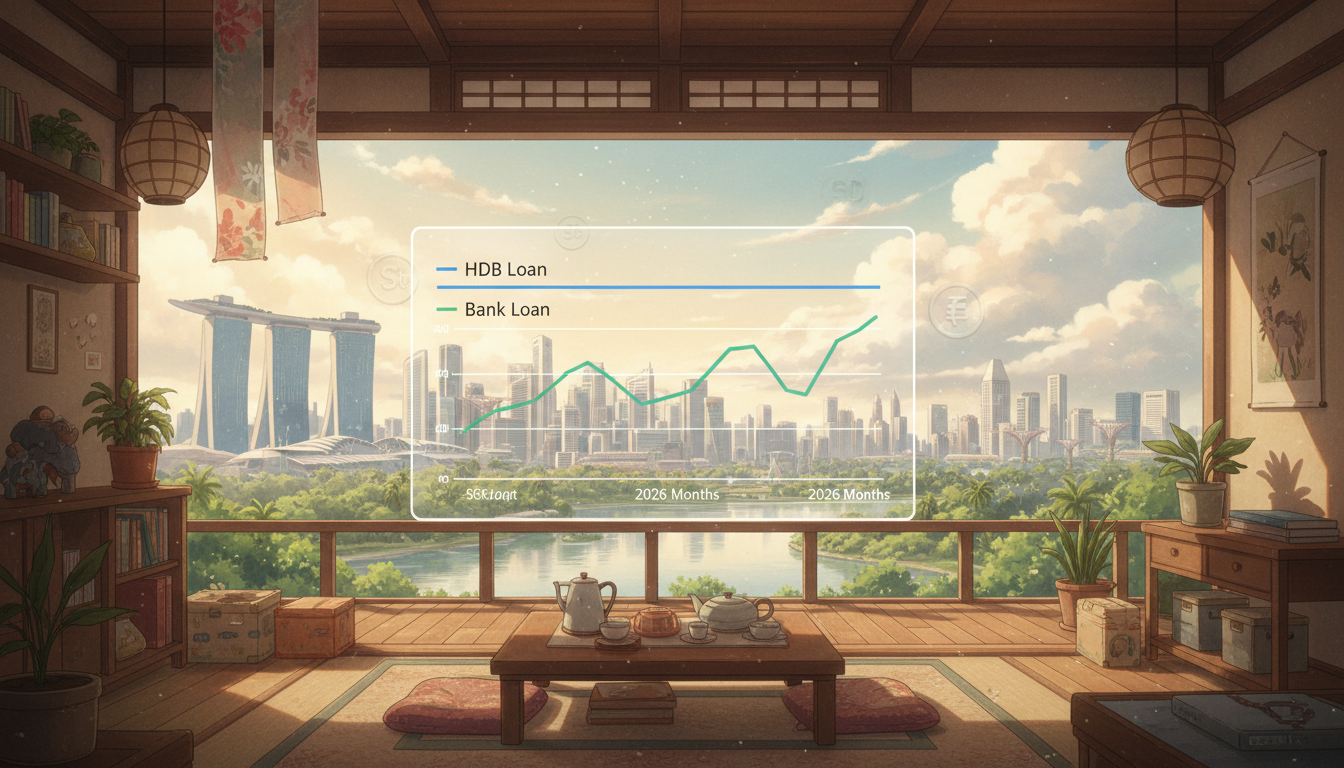
Choosing between an HDB loan vs bank loan in 2025 is one of the most important decisions you will make as a Singapore home buyer or upgrader. In simple terms: HDB loans offer stability and flexibility with a fixed 2.6% rate and no lock-in, while bank loans offer lower headline interest rates and more product choices, but with stricter criteria and market risk.[2][1]
This cluster guide supports Homejourney’s main HDB Financing Pillar Guide by zooming in on the HDB Loan vs Bank Loan 2025 Comparison, with tactical, step-by-step advice on how to choose, when to refinance, and how to structure your HDB grant financing and grant–loan combination safely.
Key 2025 Differences: HDB Loan vs Bank Loan At a Glance
For quick reference, here is a concise comparison based on 2025 data from official sources and market reports.[2][1][4][6]
- Interest rate
- Downpayment & LTV[2][1]
- Tenure
- Lock-in & penalties[2][1]
- HDB loan: No lock-in; no early redemption penalty.
- Bank loan: Usually 1–3 year lock-in; early redemption penalty ~1.5% of outstanding if you redeem or refinance within lock-in.
- Refinancing flexibility[2][1]
- You can refinance an HDB loan → bank loan later.
- You cannot refinance a bank loan → HDB loan.
In practice, for many 4-room flats in estates like Punggol, Sengkang or Bukit Panjang, this decision easily changes your lifetime interest cost by tens of thousands of dollars, so it pays to compare carefully.
Current 2025 Rate Environment: Why It Matters
Based on recent coverage of the Singapore housing market, bank home loan rates in 2025 have fallen to around 1.55%–1.8% p.a. for many fixed and floating packages, compared to HDB’s steady 2.6% p.a. concessionary rate.[4][3]
For example, The Straits Times reported that more HDB flat owners are refinancing to bank loans as interest rates dropped to a three-year low, with banks offering packages between 1.55% and 1.8%.[4] Business Times similarly highlighted that three-year fixed HDB home loan packages from major banks were about one percentage point lower than HDB’s rate.[3]
What this means in 2025:
- New buyers with stable income may benefit significantly from bank packages, especially if they are comfortable with refinancing every few years.
- Existing HDB loan borrowers can potentially save by refinancing to banks, particularly for larger outstanding loan amounts.
Homejourney helps you interpret this environment safely by letting you compare real-time rates from DBS, OCBC, UOB, HSBC, Standard Chartered, Maybank, CIMB, RHB and more via Bank Rates , and by tracking live SORA trends.
HDB Concessionary Loan: When It Still Makes Sense
The HDB loan is often the default choice for first-time buyers of BTOs or resale flats, especially in heartland areas like Yishun, Woodlands and Tampines, where many young families prefer predictable monthly payments.
Key Features of HDB Loan (2025)
- Interest: 2.6% p.a., pegged to CPF OA rate (2.5%) + 0.1%.[6]
- LTV: Up to 75% of purchase price or valuation (whichever lower).[2]
- Downpayment: Minimum 25%; can be fully paid using CPF OA savings (0% mandatory cash).[2]
- No lock-in and no early redemption penalty.[2]
- Eligibility: At least one Singapore Citizen, income ceilings, and other HDB conditions apply.
Who Is HDB Loan Best For?
- Cash-light, CPF-rich buyers: For example, a young couple in their late 20s buying a 4-room BTO in Tengah with minimal cash savings but strong CPF OA balances.
- Risk-averse families who value stability over chasing the lowest possible rate.
- Buyers with borderline credit where bank approval may be uncertain, but who meet HDB’s eligibility.
Insider tip from experience: Many buyers in mature estates like Bedok or Ang Mo Kio start with HDB loans because they are still building up emergency savings. Once their income stabilises after a few years, they review rates and often refinance via platforms like Homejourney to a cheaper bank package if conditions are favourable.
Bank Home Loans in 2025: Options, Rates, and Lock-Ins
Bank loans in 2025 come in three main flavours: fixed rate, SORA-pegged floating, and board-rate packages.[1][2] Major lenders like DBS, OCBC, UOB, HSBC, Standard Chartered, Maybank, CIMB, RHB, Public Bank, Hong Leong Bank and Citibank typically offer variations of these.
Common Bank Loan Structures
- Fixed rate (1–5 years):
- SORA-pegged floating:
- Rate = 3M or 6M SORA + fixed spread.
- Can start lower than fixed packages but will move with interest rates over time.[2]
- Board-rate / internal refinancing packages:
- Linked to the bank’s internal “board rate”.
- Less transparent; usually suitable only if you fully understand the mechanics.
As of 2025, market commentary suggests many fixed and floating bank loan packages for HDB flats are priced around 1.55%–2.2% p.a., lower than the 2.6% HDB rate.[4][5]
Bank Loans: Pros and Cons vs HDB in 2025
- Pros:
- Lower interest than HDB loan in the current rate environment → lower monthly instalments and total interest.
- More product choices to match your risk appetite (fixed vs floating; shorter vs longer lock-ins).
References